

A complete Bell polynomial 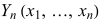 is a polynomial
that enumerates set partitions of an
 -element set, with each set
block of size
 assigned weight
 .
In the exponential convention used here, it is the sum of
the partial Bell polynomials over all possible
numbers of blocks,
 |
(1)
|
for a positive integer  , with
 .
Ordinary normalizations have different factorial weights.
In particular, the ordinary partial family rescales both the arguments and the coefficients
of the partial Bell polynomials (Di Nardo
and Guarino 2022).
The exponential generating function is
 |
(2)
|
The first few complete Bell polynomials are
 |  |  |
(3)
|
 |  |  |
(4)
|
 |  |  |
(5)
|
 |  |  |
(6)
|
Suppressing the arguments, a recurrence relation is
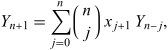 |
(7)
|
where  is a nonnegative integer. Setting every
 gives the univariate Bell polynomial
 , while setting every
 gives the Bell number.
Complete Bell polynomials express derivatives of an exponential function through Faà di Bruno's formula,
 |
(8)
|
where  is a positive integer and the necessary derivatives
exist. If
 is analytic and nonzero near a point,
with logarithmic derivative
 , this gives
 . Applying the
identity to
 gives formulas for complex residues at poles
of order
 (Liu 2001).
Complete Bell polynomials also express raw moments in terms of cumulants. For a random variable whose moment-generating function is defined near 0,
 |
(9)
|
where  is a positive integer,
 is its
 th raw moment, and
 its
 th cumulant. The identity follows
from
 , where
 is the moment-generating
function and
 the cumulant-generating
function (Di Nardo and Guarino 2022).
The complete Bell polynomial is also a special case of the generalized Bell polynomial for function composition. In the latter notation,
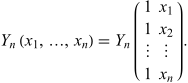 |
(10)
|
This follows by applying the Faà di Bruno formula to  ,
whose outer derivatives, after the common factor
 is removed, all equal 1.
