


The logarithm  of a positive real number
  to a positive base
  is the exponent
  for which
  . Therefore, for real
  and positive
  ,
,
 |
(1)
|
and for positive  and positive
  ,
,
 |
(2)
|
The equation  is called logarithmic form, while the equivalent
equation
is called logarithmic form, while the equivalent
equation  is called exponential form (Abramson 2021). For
example,
is called exponential form (Abramson 2021). For
example,  and
and 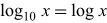 express the same relation. These
forms reflect the inverse function relation between
the logarithm and the exponential function.
express the same relation. These
forms reflect the inverse function relation between
the logarithm and the exponential function.
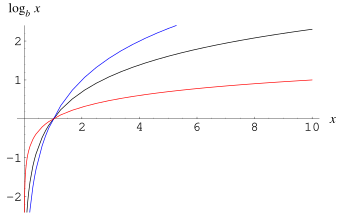
For any base, the logarithm function has a singularity at  . In the above plot, the blue curve
is the logarithm to base 2 (
. In the above plot, the blue curve
is the logarithm to base 2 ( ), the black curve is the logarithm to base
  (the natural
logarithm
(the natural
logarithm  ),
and the red curve is the logarithm to base 10 (the common
logarithm, i.e.,
),
and the red curve is the logarithm to base 10 (the common
logarithm, i.e.,  ).
).
Note that while logarithm base 10 is denoted  in this work, on calculators, and in elementary algebra
and calculus textbooks, mathematicians and advanced mathematics texts uniformly use
the notation
in this work, on calculators, and in elementary algebra
and calculus textbooks, mathematicians and advanced mathematics texts uniformly use
the notation  to mean
  ,
and therefore use
,
and therefore use  to mean the common logarithm. Extreme care is
therefore needed when consulting the literature.
to mean the common logarithm. Extreme care is
therefore needed when consulting the literature.
The situation is complicated even more by the fact that number theorists (e.g., Ivić 2003) commonly use the notation  to denote the nested
natural logarithm
to denote the nested
natural logarithm  .
.
In the Wolfram Language, the logarithm to the base  is implemented as Log[b,
x], while Log[x]
gives the natural logarithm, i.e., Log[E,
x], where E
is the Wolfram Language symbol for
e.
is implemented as Log[b,
x], while Log[x]
gives the natural logarithm, i.e., Log[E,
x], where E
is the Wolfram Language symbol for
e.
Whereas powers of trigonometric functions are denoted using notations like  ,
,  is less commonly used in favor of the notation
  .
.
Logarithms are used in many areas of science and engineering in which quantities vary over a large range. For example, the decibel scale for the loudness of sound, the Richter scale of earthquake magnitudes, and the astronomical scale of stellar brightnesses are all logarithmic scales.
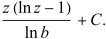
The derivative and indefinite integral of  are given by
 |  |  |
(3)
|
 |  |  |
(4)
|
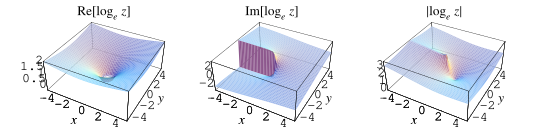
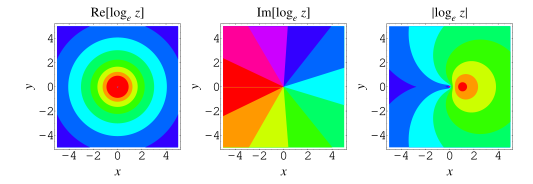
The logarithm can also be defined for complex arguments, as shown above. If the logarithm is taken as the forward function, the function taking the base to a given power is then called the antilogarithm.
For  ,
,  is called the characteristic,
and
is called the characteristic,
and  is called the mantissa.
Division and multiplication identities for the logarithm can be derived from the identity
 |
(5)
|
Specifically, for  ,
,
 |  |  |
(6)
|
 |  |  |
(7)
|
 |  |  |
(8)
|
There are a number of properties which can be used to change from one logarithm base to another, including
 |  |  |
(9)
|
 |  |  |
(10)
|
 |  |  |
(11)
|
 |  |  |
(12)
|
 |  |  |
(13)
|
 |  |  |
(14)
|
 |  |  |
(15)
|
 |  |  |
(16)
|
 |  |  |
(17)
|
An interesting property of logarithms follows from looking for a number  such that
 |
(18)
|
 |
(19)
|
 |
(20)
|
 |
(21)
|
so
 |
(22)
|
Another related identity that holds for arbitrary  is given by
 |
(23)
|
Numbers of the form  are irrational if
 and
and  are integers, one of which has
a prime factor which the other lacks. A. Baker
made a major step forward in transcendental
number theory by proving the transcendence of sums of numbers of
the form
are integers, one of which has
a prime factor which the other lacks. A. Baker
made a major step forward in transcendental
number theory by proving the transcendence of sums of numbers of
the form  for
for  and
and  algebraic numbers.

 ." 5 Nov 2003.
  ." Ch. 25 in