


The orientable genus of a graph  , denoted
  or
or  , is the minimum number of handles
that must be added to the sphere to embed
the graph without any crossings.
It is most commonly called simply the graph genus.
A graph with orientable genus 0 is embeddable
in the plane and is said to be a planar
graph. The names of graph classes having particular values for their orientable
genera are summarized in the following table (cf. West 2000, p. 266).
, is the minimum number of handles
that must be added to the sphere to embed
the graph without any crossings.
It is most commonly called simply the graph genus.
A graph with orientable genus 0 is embeddable
in the plane and is said to be a planar
graph. The names of graph classes having particular values for their orientable
genera are summarized in the following table (cf. West 2000, p. 266).

The table uses exact orientable genus: a graph in the row  has
has  . This differs from the inclusive embedding convention
in which, for example, a graph embeddable
on a torus may be called toroidal
even when it has smaller genus.
. This differs from the inclusive embedding convention
in which, for example, a graph embeddable
on a torus may be called toroidal
even when it has smaller genus.
The nonorientable genus  , also called the graph crosscap number, instead minimizes
the number of cross-caps in a nonorientable
surface containing an embedding of
, also called the graph crosscap number, instead minimizes
the number of cross-caps in a nonorientable
surface containing an embedding of  . The Euler genus of
  is the smaller of
  and
and  (Mohar 1998).
A singlecross graph has orientable genus 1, since its single graph crossing can be removed
by adding a handle. The converse is false: for example,
the complete graphs  and
and  have orientable genus 1 but graph
crossing numbers 3 and 9, respectively.
have orientable genus 1 but graph
crossing numbers 3 and 9, respectively.
Every graph has an orientable genus (White 2001, p. 53).
The smallest double-toroidal graph has 8 vertices, and there are precisely 15 double-toroidal graphs on 8 nodes.
There are no pretzel graphs on eight or fewer vertices.
Let  be an orientable surface of genus
  . If
. If  for
for  , then
  has an embedding in
  but not in
  for
for  . Furthermore,
  embeds in
  for all
  , as can be seen by adding
  handles to an embedding
of
handles to an embedding
of  in
in  (White 2001, p. 52).
The orientable genus of a graph  satisfies
 |
(1)
|
where  is the edge count of
  (White 2001, p. 53).
The orientable genus of a disconnected graph is the sum of the orientable genera of its connected components (Battle et al. 1962; White 2001, p. 55), and the orientable genus of a connected graph is the sum of the orientable genera of its blocks (Battle et al. 1962; Stahl 1978; White 2001, p. 55).
It follows from results of Battle et al. (1962) that the disjoint union of  copies of
  ,
or of
,
or of  copies of
  ,
is a forbidden minor for graphs
of orientable genus
,
is a forbidden minor for graphs
of orientable genus  .
Similarly,
.
Similarly,  copies of
  or
or  such that some share a vertex and which have blocks
that are
such that some share a vertex and which have blocks
that are  or
or  are forbidden minors for graphs
of orientable genus
are forbidden minors for graphs
of orientable genus  .
.
Duke and Haggard (1972, Harary et al. 1973) gave a criterion for the orientable genus of all graphs on 8 and fewer vertices. Define the double-toroidal graphs
 |  |  |
(2)
|
 |  |  |
(3)
|
 |  |  |
(4)
|
where  denotes
  minus the edges of
  . Then for any subgraph
  of
of  :
:
1.  if
if  does not contain a Kuratowski graph (i.e.,
  or
or  ) as a graph minor,
2.  if
if  contains a Kuratowski graph as a graph
minor (i.e., is nonplanar) but does not contain
any
contains a Kuratowski graph as a graph
minor (i.e., is nonplanar) but does not contain
any  for
for  ,
2, 3 as a subgraph,
,
2, 3 as a subgraph,
3.  if
if  contains any
  for
for  ,
2, 3 as a subgraph.
,
2, 3 as a subgraph.
The complete graph  has orientable genus
![gamma(K_n)=[((n-3)(n-4))/(12)]](/images/equations/OrientableGenus/NumberedEquation2.svg) |
(5)
|
for  ,
where
,
where ![[x]](/images/equations/OrientableGenus/Inline70.svg) is the ceiling function (Ringel and Youngs 1968;
White 1973; Harary 1994, p. 118; Asir and Chelvam 2014). The values for
is the ceiling function (Ringel and Youngs 1968;
White 1973; Harary 1994, p. 118; Asir and Chelvam 2014). The values for  , 2, ... are 0, 0, 0, 0, 1, 1, 1, 2,
3, 4, 5, 6, 8, 10, ... (OEIS A000933).
, 2, ... are 0, 0, 0, 0, 1, 1, 1, 2,
3, 4, 5, 6, 8, 10, ... (OEIS A000933).
The complete bipartite graph  has orientable genus
![gamma(K_(m,n))=[((m-2)(n-2))/4]](/images/equations/OrientableGenus/NumberedEquation3.svg) |
(6)
|
for  (Ringel 1965; Beineke and Harary 1965; White 1973; Harary 1994, p. 119; Asir
and Chelvam 2014). If either part has size 0 or 1, the complete
bipartite graph is a forest and has orientable genus
0.
(Ringel 1965; Beineke and Harary 1965; White 1973; Harary 1994, p. 119; Asir
and Chelvam 2014). If either part has size 0 or 1, the complete
bipartite graph is a forest and has orientable genus
0.
White conjectured that the orientable genus of the complete tripartite graph  with
with  is
is
![gamma_(conjectured)(K_(k,m,n))=[((k-2)(m+n-2))/4]](/images/equations/OrientableGenus/NumberedEquation4.svg) |
(7)
|
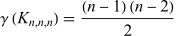
(Stahl and White 1976, Ellingham et al. 2005, Ellingham et al. 2006). While this has not been proven in general, it has been established in a number of special cases (White 1969b, Stahl and White 1976, Craft 1991, Craft 1998, Ellingham et al. 2005, Ellingham et al. 2006), including the case
 |
(8)
|
(White 1973, Asir and Chelvam 2014).
For a positive integer  , the complete multipartite
graph
, the complete multipartite
graph  has orientable genus
 |
(9)
|
(White 1973, Asir and Chelvam 2014).
The hypercube graph  has orientable genus
 |
(10)
|
for  ,
with
,
with  (Ringel 1955; Beineke and Harary 1965; Harary et al. 1988; Harary 1994, p. 119).
The values for
(Ringel 1955; Beineke and Harary 1965; Harary et al. 1988; Harary 1994, p. 119).
The values for  ,
2, ... are 0, 0, 0, 1, 5, 17, 49, 129, ... (OEIS A000337).
,
2, ... are 0, 0, 0, 1, 5, 17, 49, 129, ... (OEIS A000337).

 -Cube." Canad. J. Math. 17,
494-496, 1965.Brinkmann, G. "A Practical Algorithm for the Computation
of the Genus." 17 May 2020.
-Cube." Canad. J. Math. 17,
494-496, 1965.Brinkmann, G. "A Practical Algorithm for the Computation
of the Genus." 17 May 2020.  ."
Israel J. Math. 11, 452-455, 1972.
."
Israel J. Math. 11, 452-455, 1972.  -Connected Graph." Fund. Math. 54, 7-13,
1964.Harary, F. and Palmer, E. M.
-Connected Graph." Fund. Math. 54, 7-13,
1964.Harary, F. and Palmer, E. M.  -Octahedron: Regular Cases." J.
Graph Th. 2, 69-75, 1978.Mayer, J. "Le problème
des régions voisines sur les surfaces closes orientables." J. Combin.
Th. 6, 177-195, 1969.Metzger, A. GitHub: SanderGi/Genus.
-Octahedron: Regular Cases." J.
Graph Th. 2, 69-75, 1978.Mayer, J. "Le problème
des régions voisines sur les surfaces closes orientables." J. Combin.
Th. 6, 177-195, 1969.Metzger, A. GitHub: SanderGi/Genus.
 -dimensionalen Würfel und Würfelgitter." Abh.
Math. Sem. Univ. Hamburg 20, 10-19, 1955.Ringel, G. Färbungsprobleme
auf Flachen und Graphen. Berlin, Germany: Deutsche Verlag der Wissenschaften,
1962.Ringel, G. "Das Geschlecht des vollständiger Paaren Graphen."
Abh. Math. Sem. Univ. Hamburg 28, 139-150, 1965.Ringel,
G. and Youngs, J. W. T. "Solution of the Heawood Map-Coloring Problem."
Proc. Nat. Acad. Sci. USA 60, 438-445, 1968.Ringel, G.
and Youngs, J. W. T. "Remarks on the Heawood Conjecture." In
-dimensionalen Würfel und Würfelgitter." Abh.
Math. Sem. Univ. Hamburg 20, 10-19, 1955.Ringel, G. Färbungsprobleme
auf Flachen und Graphen. Berlin, Germany: Deutsche Verlag der Wissenschaften,
1962.Ringel, G. "Das Geschlecht des vollständiger Paaren Graphen."
Abh. Math. Sem. Univ. Hamburg 28, 139-150, 1965.Ringel,
G. and Youngs, J. W. T. "Solution of the Heawood Map-Coloring Problem."
Proc. Nat. Acad. Sci. USA 60, 438-445, 1968.Ringel, G.
and Youngs, J. W. T. "Remarks on the Heawood Conjecture." In
 ." J. Combin. Th. 7, 283-285, 1969b.White,
A. T. Graphs, Groups and Surfaces. Amsterdam, Netherlands: North-Holland,
1973.White, A. T. "Imbedding Problems in Graph Theory."
Ch. 6 in Graphs of Groups on Surfaces: Interactions and Models (Ed. A. T. White).
Amsterdam, Netherlands: Elsevier, pp. 49-72, 2001.
." J. Combin. Th. 7, 283-285, 1969b.White,
A. T. Graphs, Groups and Surfaces. Amsterdam, Netherlands: North-Holland,
1973.White, A. T. "Imbedding Problems in Graph Theory."
Ch. 6 in Graphs of Groups on Surfaces: Interactions and Models (Ed. A. T. White).
Amsterdam, Netherlands: Elsevier, pp. 49-72, 2001.