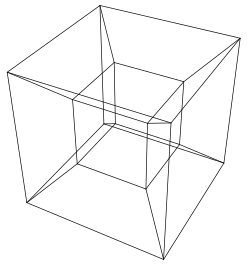
The hypercube is a generalization of a 3-cube to dimensions, also called an -cube or measure polytope. It is a regular polytope
with mutually perpendicular sides, and is therefore
an orthotope. It is denoted and has Schläfli
symbol.
The following table summarizes the names of -dimensional hypercubes.
The number of -cubes
contained in an -cube
can be found from the coefficients of , namely , where is a binomial coefficient.
The number of nodes in the -hypercube
is therefore
(OEIS A000079), the number of edges is (OEIS A001787),
the number of squares is
(OEIS A001788), the number of cubes is (OEIS A001789),
etc.
The numbers of distinct nets for the -hypercube for , 2, ... are 1, 11, 261, ... (OEIS A091159;
Turney 1984-85).
The dual of the tesseract is known as the 16-cell. For all dimensions, the dual of the hypercube is the cross
polytope (and vice versa).
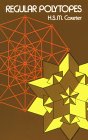
An isometric projection of the 5-hypercube appears together with the great rhombic triacontahedron on the cover of Coxeter's well-known book on polytopes
(Coxeter 1973).
Wilker (1996) considers the point in an -cube that maximizes the products of distances to its vertices
(Trott 2004, p. 104). The following table summarizes results for small .



 dimensions, also called an
  -cube or measure polytope. It is a regular polytope
with mutually perpendicular sides, and is therefore
an orthotope. It is denoted
-cube or measure polytope. It is a regular polytope
with mutually perpendicular sides, and is therefore
an orthotope. It is denoted  and has Schläfli
symbol
and has Schläfli
symbol  .
.
 -dimensional hypercubes.

 -cubes
contained in an
-cubes
contained in an  -cube
can be found from the coefficients of
-cube
can be found from the coefficients of  , namely
  , where
  is a binomial coefficient.
The number of nodes in the
is a binomial coefficient.
The number of nodes in the  -hypercube
is therefore
-hypercube
is therefore  (OEIS A000079), the number of edges is
  (OEIS A001787),
the number of squares is
(OEIS A001787),
the number of squares is  (OEIS A001788), the number of cubes is
  (OEIS A001789),
etc.
(OEIS A001789),
etc.
 -hypercube for
  , 2, ... are 1, 11, 261, ... (OEIS A091159;
Turney 1984-85).
, 2, ... are 1, 11, 261, ... (OEIS A091159;
Turney 1984-85).
 -cube that maximizes the products of distances to its vertices
(Trott 2004, p. 104). The following table summarizes results for small
-cube that maximizes the products of distances to its vertices
(Trott 2004, p. 104). The following table summarizes results for small  .
.


