


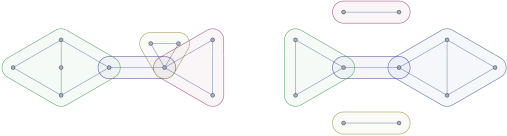
A graph block (or simply block) of a graph  is a maximal connected subgraph having no articulation
vertex (West 2000, p. 155). The graph blocks of a loopless graph are its
isolated vertices, bridges,
and maximal 2-connected subgraphs (West 2000, p. 155; Gross and Yellen 2006,
p. 241). Examples of graphs with their corresponding blocks due to Harary (1994,
p. 26) and West (2000, p. 155) are illustrated above.
is a maximal connected subgraph having no articulation
vertex (West 2000, p. 155). The graph blocks of a loopless graph are its
isolated vertices, bridges,
and maximal 2-connected subgraphs (West 2000, p. 155; Gross and Yellen 2006,
p. 241). Examples of graphs with their corresponding blocks due to Harary (1994,
p. 26) and West (2000, p. 155) are illustrated above.
Distinct graph blocks have at most one graph vertex in common, and any common vertex is an articulation vertex. If a block has more than two vertices, then it is biconnected. A connected graph consisting of a single block is also called a nonseparable graph.
Graph blocks arise in graph-theoretical problems such as finding unit-distance graphs and the graph genus of connected graphs. For example, a connected graph is unit-distance iff each of its blocks is unit-distance, and the graph coarseness of a graph is the sum of the coarsenesses of its blocks. The graph genus is likewise the sum of the genera of the blocks. By contrast, the chromatic number of a graph is the maximum of the chromatic numbers of its blocks.
