


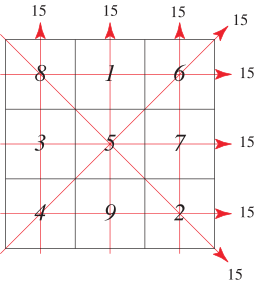
A magic square is a square array of numbers consisting of the distinct positive integers 1, 2, ...,  arranged such that the sum of the
  numbers in any horizontal, vertical, or main diagonal
line is always the same number (Kraitchik 1942, p. 142; Andrews 1960, p. 1;
Gardner 1961, p. 130; Madachy 1979, p. 84; Benson and Jacoby 1981, p. 3;
Ball and Coxeter 1987, p. 193), known as the magic
constant
numbers in any horizontal, vertical, or main diagonal
line is always the same number (Kraitchik 1942, p. 142; Andrews 1960, p. 1;
Gardner 1961, p. 130; Madachy 1979, p. 84; Benson and Jacoby 1981, p. 3;
Ball and Coxeter 1987, p. 193), known as the magic
constant
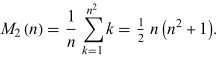 |
If every number in a magic square is subtracted from  , another magic square is obtained called the complementary
magic square. A square consisting of consecutive numbers starting with 1 is sometimes
known as a "normal" magic square.
, another magic square is obtained called the complementary
magic square. A square consisting of consecutive numbers starting with 1 is sometimes
known as a "normal" magic square.
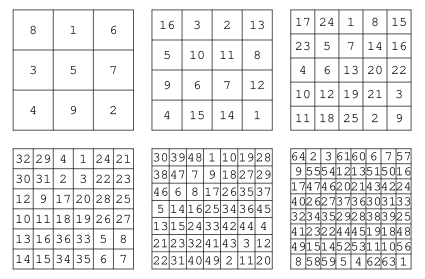
The unique normal square of order three was known to the ancient Chinese, who called it the Lo Shu. A version of the order-4 magic square with the numbers 15 and 14 in adjacent middle columns in the bottom row is called Dürer's magic square. Magic squares of order 3 through 8 are shown above.
The magic constant for an  th order general magic square starting with an integer
  and with entries in an increasing arithmetic series with difference
  between terms is
![M_2(n;A,D)=1/2n[2a+D(n^2-1)]](/images/equations/MagicSquare/NumberedEquation2.svg) |
(Hunter and Madachy 1975).
It is an unsolved problem to determine the number of magic squares of an arbitrary order, but the number of distinct magic squares (excluding those obtained by rotation
and reflection) of order  ,
2, ... are 1, 0, 1, 880, 275305224, ... (OEIS A006052;
Madachy 1979, p. 87). The 880 squares of order four were enumerated by Frénicle
de Bessy in 1693, and are illustrated in Berlekamp et al. (1982, pp. 778-783).
The number of
,
2, ... are 1, 0, 1, 880, 275305224, ... (OEIS A006052;
Madachy 1979, p. 87). The 880 squares of order four were enumerated by Frénicle
de Bessy in 1693, and are illustrated in Berlekamp et al. (1982, pp. 778-783).
The number of  magic squares was computed by R. Schroeppel in 1973. The number of
  squares is not known, but Pinn and Wieczerkowski (1998)
estimated it to be
squares is not known, but Pinn and Wieczerkowski (1998)
estimated it to be  using Monte Carlo simulation and methods from statistical mechanics. Methods for
enumerating magic squares are discussed by Berlekamp et al. (1982) and on
the MathPages website.
using Monte Carlo simulation and methods from statistical mechanics. Methods for
enumerating magic squares are discussed by Berlekamp et al. (1982) and on
the MathPages website.
A square that fails to be magic only because one or both of the main diagonal sums do not equal the magic constant is called a semimagic square. If all diagonals (including
those obtained by wrapping around) of a magic square sum to the magic
constant, the square is said to be a panmagic
square (also called a diabolic square or pandiagonal square). If replacing each
number  by its square
  produces another magic square, the square is said to be a bimagic
square (or doubly magic square). If a square is magic for
produces another magic square, the square is said to be a bimagic
square (or doubly magic square). If a square is magic for  ,
,  ,
and
,
and  , it is called a trimagic
square (or trebly magic square). If all pairs of numbers symmetrically opposite
the center sum to
, it is called a trimagic
square (or trebly magic square). If all pairs of numbers symmetrically opposite
the center sum to  ,
the square is said to be an associative magic
square.
,
the square is said to be an associative magic
square.
Squares that are magic under multiplication instead of addition can be constructed and are known as multiplication magic squares. In addition, squares that are magic under both addition and multiplication can be constructed and are known as addition-multiplication magic squares (Hunter and Madachy 1975).
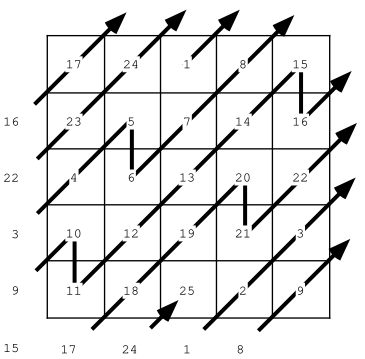
Kraitchik (1942) gives general techniques of constructing even and odd squares of order  . For
. For  odd, a very straightforward
technique known as the Siamese method can be used, as illustrated above (Kraitchik
1942, pp. 148-149). It begins by placing a 1 in the center square of the top
row, then incrementally placing subsequent numbers in the square one unit above and
to the right. The counting is wrapped around, so that falling off the top returns
on the bottom and falling off the right returns on the left. When a square is encountered
that is already filled, the next number is instead placed below the previous
one and the method continues as before. The method, also called de la Loubere's method,
is purported to have been first reported in the West when de la Loubere returned
to France after serving as ambassador to Siam.
odd, a very straightforward
technique known as the Siamese method can be used, as illustrated above (Kraitchik
1942, pp. 148-149). It begins by placing a 1 in the center square of the top
row, then incrementally placing subsequent numbers in the square one unit above and
to the right. The counting is wrapped around, so that falling off the top returns
on the bottom and falling off the right returns on the left. When a square is encountered
that is already filled, the next number is instead placed below the previous
one and the method continues as before. The method, also called de la Loubere's method,
is purported to have been first reported in the West when de la Loubere returned
to France after serving as ambassador to Siam.
A generalization of this method uses an "ordinary vector"  that gives the offset for each noncolliding move and a
"break vector"
that gives the offset for each noncolliding move and a
"break vector"  that gives the offset to introduce upon a collision. The standard Siamese method
therefore has ordinary vector (1,
that gives the offset to introduce upon a collision. The standard Siamese method
therefore has ordinary vector (1,  ) and break vector (0, 1). In order for this to produce a
magic square, each break move must end up on an unfilled cell. Special classes of
magic squares can be constructed by considering the absolute sums
) and break vector (0, 1). In order for this to produce a
magic square, each break move must end up on an unfilled cell. Special classes of
magic squares can be constructed by considering the absolute sums  ,
,  ,
,  , and
, and  . Call the set of these numbers the sumdiffs
(sums and differences). If all sumdiffs are relatively
prime to
. Call the set of these numbers the sumdiffs
(sums and differences). If all sumdiffs are relatively
prime to  and the square is a magic square, then the square is also a panmagic
square. This theory originated with de la Hire. The following table gives the
sumdiffs for particular choices of ordinary and break vectors.
and the square is a magic square, then the square is also a panmagic
square. This theory originated with de la Hire. The following table gives the
sumdiffs for particular choices of ordinary and break vectors.
| ordinary vector | break vector | sumdiffs | magic squares | panmagic squares |
(1,  ) ) | (0, 1) | (1, 3) |  | none |
(1,  ) ) | (0, 2) | (0, 2) |  | none |
| (2, 1) | (1,
 ) ) | (1, 2, 3, 4) |  | none |
| (2, 1) | (1,
 ) ) | (0, 1, 2, 3) |  |  |
| (2, 1) | (1, 0) | (0, 1, 2) |  | none |
| (2, 1) | (1, 2) | (0, 1, 2, 3) |  | none |
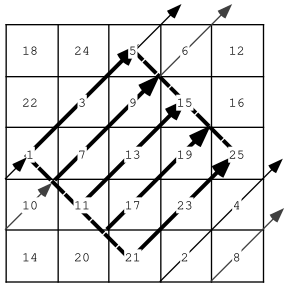
A second method for generating magic squares of odd order has been discussed by J. H. Conway under the name of the "lozenge" method. As illustrated above, in this method, the odd numbers are built up along diagonal lines in the shape of a diamond in the central part of the square. The even numbers that were missed are then added sequentially along the continuation of the diagonal obtained by wrapping around the square until the wrapped diagonal reaches its initial point. In the above square, the first diagonal therefore fills in 1, 3, 5, 2, 4, the second diagonal fills in 7, 9, 6, 8, 10, and so on.
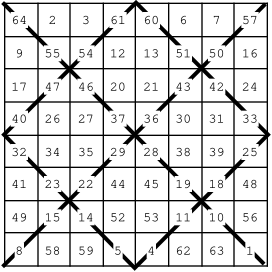
An elegant method for constructing magic squares of doubly even order  is to draw
  s
through each
s
through each  subsquare and fill all squares in sequence. Then replace each entry
  on a crossed-off diagonal by
  or, equivalently, reverse the order of the crossed-out
entries. Thus in the above example for
or, equivalently, reverse the order of the crossed-out
entries. Thus in the above example for  , the crossed-out numbers are originally 1, 4, ..., 61, 64,
so entry 1 is replaced with 64, 4 with 61, etc.
, the crossed-out numbers are originally 1, 4, ..., 61, 64,
so entry 1 is replaced with 64, 4 with 61, etc.
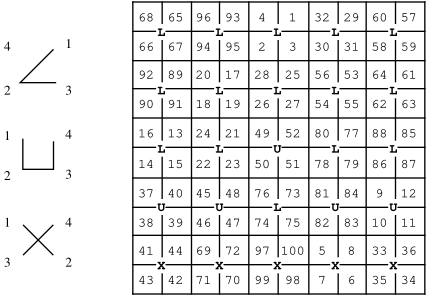
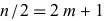
A very elegant method for constructing magic squares of singly even order  with
with  (there is no magic square of order 2) is due to J. H. Conway, who calls
it the "LUX" method. Create an array consisting of
(there is no magic square of order 2) is due to J. H. Conway, who calls
it the "LUX" method. Create an array consisting of  rows of
  s, 1 row of Us, and
  rows of
  s, all of length
  . Interchange the middle U with the L above it. Now
generate the magic square of order
. Interchange the middle U with the L above it. Now
generate the magic square of order  using the Siamese method centered on the array of letters
(starting in the center square of the top row), but fill each set of four squares
surrounding a letter sequentially according to the order prescribed by the letter.
That order is illustrated on the left side of the above figure, and the completed
square is illustrated to the right. The "shapes" of the letters L, U, and
X naturally suggest the filling order, hence the name of the algorithm.
using the Siamese method centered on the array of letters
(starting in the center square of the top row), but fill each set of four squares
surrounding a letter sequentially according to the order prescribed by the letter.
That order is illustrated on the left side of the above figure, and the completed
square is illustrated to the right. The "shapes" of the letters L, U, and
X naturally suggest the filling order, hence the name of the algorithm.
Variations on magic squares can also be constructed using letters (either in defining the square or as entries in it), such as the alphamagic square and templar magic square.
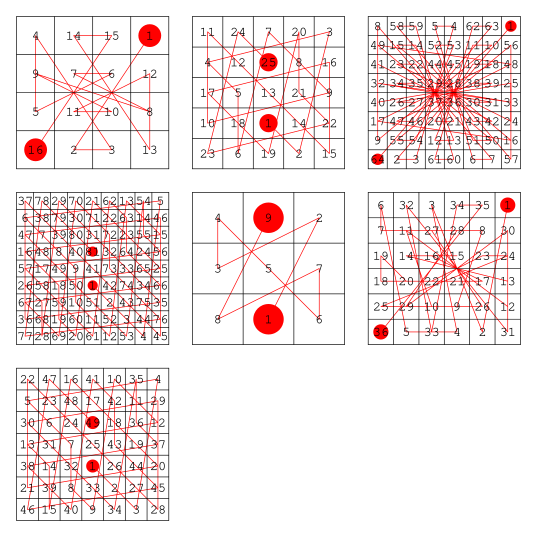
Various numerological properties have also been associated with magic squares. Pivari associates the squares illustrated above with Saturn, Jupiter, Mars, the Sun, Venus, Mercury, and the Moon, respectively. Attractive patterns are obtained by connecting consecutive numbers in each of the squares (with the exception of the Sun magic square).
