Two integers are relatively prime if they share no common positive factors (divisors) except 1. Using the notation to denote the greatest
common divisor, two integers and are relatively prime if . Relatively prime integers are sometimes also called
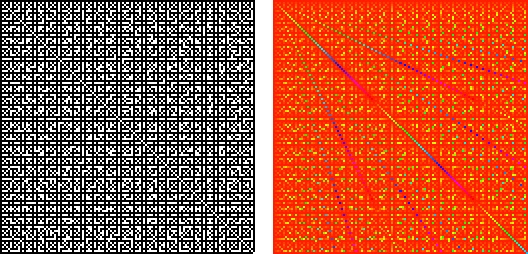
strangers or coprime and are denoted . The plot above plots and along the two axes and colors a square black if and white otherwise (left figure) and simply colored
according to
(right figure).
Two numbers can be tested to see if they are relatively prime in the Wolfram Language using CoprimeQ[m,
n].
Two distinct primes
and
are always relatively prime, , as are any positive integer powers of distinct primes
and , .
Relative primality is not transitive. For example, and , but .
The probability that two integers and picked at random are relatively prime is
(1)
(OEIS A059956; Cesàro and Sylvester 1883; Lehmer 1900; Sylvester 1909; Nymann 1972; Wells 1986, p. 28; Borwein and
Bailey 2003, p. 139; Havil 2003, pp. 40 and 65; Moree 2005), where is the Riemann
zeta function. This result is related to the fact that the greatest
common divisor of
and ,
, can be interpreted as the number
of lattice points in the plane
which lie on the straight line connecting the vectors and (excluding itself). In fact, is the fractional number of lattice
pointsvisible from the origin
(Castellanos 1988, pp. 155-156).
Given three integers chosen at random, the probability that no common factor
will divide them all is
(2)
(OEIS A088453; Wells 1986, p. 29), where is Apéry's
constant (Wells 1986, p. 29). In general, the probability that random numbers lack a th power common divisor is (Cohen 1959, Salamin 1972, Nymann 1975, Schoenfeld
1976, Porubský 1981, Chidambaraswamy and Sitaramachandra Rao 1987, Hafner
et al. 1993).
Interestingly, the probability that two Gaussian integers
and
are relatively prime is
Amazingly, the probabilities for random pairs of integers and Gaussian integers being relatively prime are the same as the asymptotic densities of squarefree
integers of these types.
Borwein, J. and Bailey, D. Mathematics by Experiment: Plausible Reasoning in the 21st Century. Wellesley, MA: A
K Peters, 2003.Castellanos, D. "The Ubiquitous Pi." Math.
Mag.61, 67-98, 1988.Chidambaraswamy, J. and Sitaramachandra
Rao, R. "On the Probability That the Values of M Polynomials Have a Given G.C.D."
J. Number Th.26, 237-245, 1987.Cohen, E. "Arithmetical
Functions Associated with Arbitrary Sets of Integers." Acta Arith.5,
407-415, 1959.Collins, G. E. and Johnson, J. R. "The
Probability of Relative Primality of Gaussian Integers." Proc. 1988 Internat.
Sympos. Symbolic and Algebraic Computation (ISAAC), Rome (Ed. P. Gianni).
New York: Springer-Verlag, pp. 252-258, 1989.Finch, S. R.
Mathematical
Constants. Cambridge, England: Cambridge University Press, 2003.Guy,
R. K. Unsolved
Problems in Number Theory, 2nd ed. New York: Springer-Verlag, pp. 3-4,
1994.Hafner, J. L.; Sarnak, P.; and McCurley, K. "Relatively
Prime Values of Polynomials." In A
Tribute to Emil Grosswald: Number Theory and Related Analysis (Ed. M. Knopp
and M. Seingorn). Providence, RI: Amer. Math. Soc., 1993.Havil,
J. Gamma:
Exploring Euler's Constant. Princeton, NJ: Princeton University Press, 2003.Hoffman,
P. The
Man Who Loved Only Numbers: The Story of Paul Erdős and the Search for Mathematical
Truth. New York: Hyperion, pp. 38-39, 1998.Lehmer, D. N.
"An Asymptotic Evaluation of Certain Totient Sums." Amer. J. Math.22,
293-355, 1900.Moree, P. "Counting Carefree Couples." 30 Sep
2005. https://arxiv.org/abs/math/0510003.Nagell,
T. "Relatively Prime Numbers. Euler's -Function." §8 in Introduction
to Number Theory. New York: Wiley, pp. 23-26, 1951.Nymann,
J. E. "On the Probability That Positive Integers Are Relatively Prime." J. Number
Th.4, 469-473, 1972.Nymann, J. E. "On the Probability
That
Positive Integers Are Relatively Prime. II." J. Number Th.7,
406-412, 1975.Pegg, E. Jr. "MathPuzzle: The Neglected Gaussian
Integers." Sep. 17, 2003. https://www.mathpuzzle.com/Gaussians.html.Porubský,
S. "On the Probability That K Generalized Integers Are Relatively H-Prime."
Colloq. Math.45, 91-99, 1981.Salamin, E. Item 53 in Beeler,
M.; Gosper, R. W.; and Schroeppel, R. HAKMEM. Cambridge, MA: MIT Artificial
Intelligence Laboratory, Memo AIM-239, p. 22, Feb. 1972. https://www.inwap.com/pdp10/hbaker/hakmem/number.html#item53.Schoenfeld,
L. "Sharper Bounds for the Chebyshev Functions and , II." Math. Comput.30, 337-360, 1976.Sloane,
N. J. A. Sequences A059956, A086724,
A088453, A088454,
and A088467 in "The On-Line Encyclopedia
of Integer Sequences."Wells, D. The
Penguin Dictionary of Curious and Interesting Numbers. Middlesex, England:
Penguin Books, pp. 28-29, 1986.


 to denote the greatest
common divisor, two integers
to denote the greatest
common divisor, two integers  and
and  are relatively prime if
  . Relatively prime integers are sometimes also called
strangers or coprime and are denoted
. Relatively prime integers are sometimes also called
strangers or coprime and are denoted  . The plot above plots
  and
and  along the two axes and colors a square black if
  and white otherwise (left figure) and simply colored
according to
and white otherwise (left figure) and simply colored
according to  (right figure).
 and
and  are always relatively prime,
  , as are any positive integer powers of distinct primes
 and
and  ,
,  .
.
 and
and  , but
, but  .
.
 and
and  picked at random are relatively prime is
![P((m,n)=1)=[zeta(2)]^(-1)=6/(pi^2)=0.60792...](/images/equations/RelativelyPrime/NumberedEquation1.svg)
 is the Riemann
zeta function. This result is related to the fact that the greatest
common divisor of
is the Riemann
zeta function. This result is related to the fact that the greatest
common divisor of  and
and  ,
,
 , can be interpreted as the number
of lattice points in the plane
which lie on the straight line connecting the vectors
, can be interpreted as the number
of lattice points in the plane
which lie on the straight line connecting the vectors  and
and  (excluding
  itself). In fact,
  is the fractional number of lattice
points visible from the origin
(Castellanos 1988, pp. 155-156).
is the fractional number of lattice
points visible from the origin
(Castellanos 1988, pp. 155-156).
 chosen at random, the probability that no common factor
will divide them all is
chosen at random, the probability that no common factor
will divide them all is
![P((k,m,n)=1)=[zeta(3)]^(-1)=0.83190...](/images/equations/RelativelyPrime/NumberedEquation2.svg)
 is Apéry's
constant (Wells 1986, p. 29). In general, the probability that
is Apéry's
constant (Wells 1986, p. 29). In general, the probability that  random numbers lack a
  th power common divisor is
 ![[zeta(np)]^(-1)](/images/equations/RelativelyPrime/Inline33.svg) (Cohen 1959, Salamin 1972, Nymann 1975, Schoenfeld
1976, Porubský 1981, Chidambaraswamy and Sitaramachandra Rao 1987, Hafner
et al. 1993).
(Cohen 1959, Salamin 1972, Nymann 1975, Schoenfeld
1976, Porubský 1981, Chidambaraswamy and Sitaramachandra Rao 1987, Hafner
et al. 1993).
 and
and  are relatively prime is

 is Catalan's constant
(Pegg; Collins and Johnson 1989; Finch 2003, p. 601).
is Catalan's constant
(Pegg; Collins and Johnson 1989; Finch 2003, p. 601).

![H=sum_(k=0)^infty[1/((3k+1)^2)-1/((3k+2)^2)]](/images/equations/RelativelyPrime/NumberedEquation5.svg)


![1/9[psi_1(1/3)-psi_1(2/3)]](/images/equations/RelativelyPrime/Inline39.svg)


 is the trigamma function

 -Function." §8 in
  Positive Integers Are Relatively Prime." J. Number
Th. 4, 469-473, 1972.Nymann, J. E. "On the Probability
That
Positive Integers Are Relatively Prime." J. Number
Th. 4, 469-473, 1972.Nymann, J. E. "On the Probability
That  Positive Integers Are Relatively Prime. II." J. Number Th. 7,
406-412, 1975.Pegg, E. Jr. "MathPuzzle: The Neglected Gaussian
Integers." Sep. 17, 2003.
Positive Integers Are Relatively Prime. II." J. Number Th. 7,
406-412, 1975.Pegg, E. Jr. "MathPuzzle: The Neglected Gaussian
Integers." Sep. 17, 2003.  and
and  , II." Math. Comput. 30, 337-360, 1976.Sloane,
N. J. A. Sequences
, II." Math. Comput. 30, 337-360, 1976.Sloane,
N. J. A. Sequences