A multiplication magic square is an array of distinct positive
integers for which the product of the entries in
each row, each column, and each of the two main diagonals
is the same. This common product is its multiplicative
magic constant. Unlike a normal magic
square, whose defining operation is addition, the entries need not be consecutive.
The above multiplication magic square has a multiplicative magic constant of 4096 and was found by Antoine Arnauld in Nouveaux Eléments
de Géométrie, Paris in 1667 (Boyer).
The smallest possible multiplicative magic constants for ,
,
... are 216, 5040, 302400, 25945920, ... (OEIS A114060).
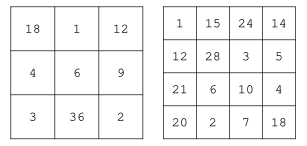
The
solution (left) was found by Sayles in 1913 and also published by Dudeney (1917).
Sayles also found the solution (right), which was subsequently proved to
be minimal by Borkovitz and Hwang (1983). The series of best known smallest largest
element for an multiplication magic square with , 4, ... begins 36, 28, 45, 66, 91, 160, 225, ... (Boyer).


 array of distinct positive
integers for which the product of the entries in
each row, each column, and each of the two main diagonals
is the same. This common product is its multiplicative
magic constant. Unlike a normal magic
square, whose defining operation is addition, the
 entries need not be consecutive.

 ,
 ,
... are 216, 5040, 302400, 25945920, ... (OEIS A114060).
The
 solution (left) was found by Sayles in 1913 and also published by Dudeney (1917).
Sayles also found the
 solution (right), which was subsequently proved to
be minimal by Borkovitz and Hwang (1983). The series of best known smallest largest
element for an
 multiplication magic square with
 , 4, ... begins 36, 28, 45, 66, 91, 160, 225, ... (Boyer).
