


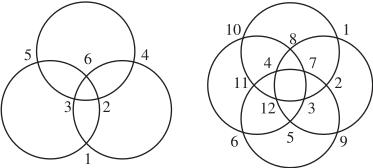
A set of  magic circles is a numbering of the intersections of the
 circles such
that the sum over all intersections is the same constant for all circles.
The above sets of three and four magic circles have magic
constants 14 and 39 (Madachy 1979). If each pair of circles
intersects twice, all intersections are distinct, and the labels are the integers
1, 2, ...,
 ,
then each label contributes to two circle sums. Thus the magic
constant, whenever such a labeling exists, is
 . For
 , 3, ..., these values are 3, 14, 39, 84, 155, 258, ... (OEIS
A027444, with its index shifted by 1).

Another type of magic circle arranges the numbers 1, 2, ...,  in a number of rings, with each ring containing the same number
of elements and corresponding elements being connected with radial lines. One of
the numbers (which is subsequently ignored) is placed at the center. In a magic circle
arrangement, the rings have equal sums and this sum is also equal to the sum of elements
along each diameter (excluding the central number).
Three magic circles using the numbers 1 to 33 are illustrated above.

