


An  Latin square is a Latin
rectangle with
Latin square is a Latin
rectangle with  .
Its
.
Its  entries are chosen from
  symbols, each appearing exactly once in every row and every
column. For example, the two Latin squares of order two are given by
symbols, each appearing exactly once in every row and every
column. For example, the two Latin squares of order two are given by
![[1 2; 2 1],[2 1; 1 2],](/images/equations/LatinSquare/NumberedEquation1.svg) |
(1)
|
the 12 Latin squares of order three are given by
![[1 2 3; 2 3 1; 3 1 2],[1 2 3; 3 1 2; 2 3 1],[1 3 2; 2 1 3; 3 2 1],[1 3 2; 3 2 1; 2 1 3],
[2 1 3; 1 3 2; 3 2 1],[2 1 3; 3 2 1; 1 3 2],[2 3 1; 1 2 3; 3 1 2],[2 3 1; 3 1 2; 1 2 3],
[3 2 1; 1 3 2; 2 1 3],[3 2 1; 2 1 3; 1 3 2],[3 1 2; 1 2 3; 2 3 1],[3 1 2; 2 3 1; 1 2 3],](/images/equations/LatinSquare/NumberedEquation2.svg) |
(2)
|
and two of the 576 Latin squares of order 4 are given by
![[1 2 3 4; 2 1 4 3; 3 4 1 2; 4 3 2 1] and [1 2 3 4; 3 4 1 2; 4 3 2 1; 2 1 4 3].](/images/equations/LatinSquare/NumberedEquation3.svg) |
(3)
|
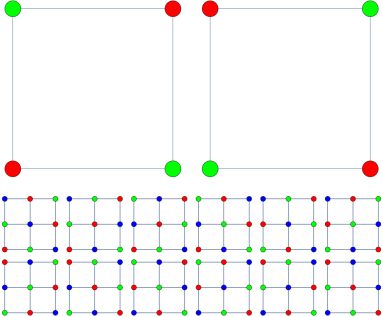
Latin squares correspond to minimum vertex colorings of the  rook graph, which are illustrated above for
  and 3.
The numbers  of Latin squares of order
  ,
2, ... are 1, 2, 12, 576, 161280, ... (OEIS A002860).
The numbers
,
2, ... are 1, 2, 12, 576, 161280, ... (OEIS A002860).
The numbers  of isotopically distinct Latin squares of order
  , 2, ... are 1, 1, 1, 2, 2, 22, 564, 1676267, ... (OEIS A040082).
A pair of Latin squares is said to be orthogonal if the  pairs formed by juxtaposing the two arrays
are all distinct. For example, the two Latin squares
pairs formed by juxtaposing the two arrays
are all distinct. For example, the two Latin squares
![[3 2 1; 2 1 3; 1 3 2] [2 3 1; 1 2 3; 3 1 2]](/images/equations/LatinSquare/NumberedEquation4.svg) |
(4)
|
are orthogonal. The numbers of unordered pairs of orthogonal Latin squares of order  , 2, ... are 1, 0, 36, 3456, ... (OEIS
A072377). The count at order 1 includes the
unique Latin square paired with itself.
, 2, ... are 1, 0, 36, 3456, ... (OEIS
A072377). The count at order 1 includes the
unique Latin square paired with itself.
The number of Latin squares of order  with first row given by
  is the same as the number of fixed diagonal Latin
squares of order
is the same as the number of fixed diagonal Latin
squares of order  (i.e., the number of Latin squares of order
  having all 1s along their main diagonals). For
  , 2, ..., the numbers of such matrices
are 1, 1, 2, 24, 1344, 1128960, ... (OEIS A000479)
and the total number of Latin squares of order
, 2, ..., the numbers of such matrices
are 1, 1, 2, 24, 1344, 1128960, ... (OEIS A000479)
and the total number of Latin squares of order  is equal to this number times
  .
.
A normalized, or reduced, Latin square is a Latin square with the first row and column given by  .
General formulas for the number of normalized
.
General formulas for the number of normalized  Latin squares
  are given by Nechvatal (1981), Gessel (1987), and Shao
and Wei (1992), but a sharp asymptotic equivalent
for
are given by Nechvatal (1981), Gessel (1987), and Shao
and Wei (1992), but a sharp asymptotic equivalent
for  is not known (McKay and Wanless
2005, p. 336). The total number of Latin squares
is not known (McKay and Wanless
2005, p. 336). The total number of Latin squares  of order
  can then be computed from
 |
(5)
|
The known growth on a logarithmic scale is  (Linial and Luria 2014), where
  denotes little-O
notation.
denotes little-O
notation.
The numbers of normalized Latin squares of order  , 2, ..., are summarized in the following table (OEIS A000315). The entries for
  , 13, 14, and 15 are estimates (McKay and Rogoyski 1995).
 |  | reference |
| 1 | 1 | |
| 2 | 1 | |
| 3 | 1 | |
| 4 | 4 | |
| 5 | 56 | Euler (1782), Cayley (1890), MacMahon (1915; incorrect value) |
| 6 | 9408 | Frolov (1890) and Tarry (1900) |
| 7 | 16942080 | Frolov (1890; incorrect), Norton (1939; incomplete), Sade (1948), Saxena (1951) |
| 8 | 535281401856 | Wells (1967) |
| 9 | 377597570964258816 | Bammel and Rothstein (1975) |
| 10 | 7580721483160132811489280 | McKay and Rogoyski (1995) |
| 11 | 5363937773277371298119673540771840 | McKay and Wanless (2005) |
| 12 |  | McKay and Rogoyski (1995) |
| 13 |  | McKay and Rogoyski (1995) |
| 14 |  | McKay and Rogoyski (1995) |
| 15 |  | McKay and Rogoyski (1995) |
Sudoku is a special case of a Latin square.
Greenhill et al. (2026) proved that a uniformly random Latin square of order  has every row an even
permutation with probability
has every row an even
permutation with probability  as
as  . Their stronger theorem
prescribes which row, column, and symbol permutations
are even or odd,
subject to the necessary parity identity.
. Their stronger theorem
prescribes which row, column, and symbol permutations
are even or odd,
subject to the necessary parity identity.
The fewest entries needed to specify a Latin square uniquely are studied using Latin square critical sets, minimal collections
of entries with a unique completion. Bean (2026) reports that the least size over
all Latin squares of order  is
is  ,
where
,
where  is the floor function. The claimed proof is based
on an all-orders parity theorem for completions, not merely on finite checks. Bean
(2026) attributes substantial proof generation to Codex and Claude with human direction
and review. The general argument has not been independently verified here.
is the floor function. The claimed proof is based
on an all-orders parity theorem for completions, not merely on finite checks. Bean
(2026) attributes substantial proof generation to Codex and Claude with human direction
and review. The general argument has not been independently verified here.

 Latin Squares." Disc.
Math. 11, 93-95, 1975.Bean, R. "A Counting Proof for
the Smallest Critical Set in a Latin Square." 13 Oct 2026.
Latin Squares." Disc.
Math. 11, 93-95, 1975.Bean, R. "A Counting Proof for
the Smallest Critical Set in a Latin Square." 13 Oct 2026.  Squares." Ann. Eugenics 9, 269-307,
1939.Rohl, J. S.
Squares." Ann. Eugenics 9, 269-307,
1939.Rohl, J. S.  Latin Squares." J. Indian Soc. Agricultural
Statist. 3, 24-79, 1951.Shao, J.-Y. and Wei, W.-D. "A
Formula for the Number of Latin Squares." Disc. Math. 110, 293-296,
1992.Sloane, N. J. A. Sequences
Latin Squares." J. Indian Soc. Agricultural
Statist. 3, 24-79, 1951.Shao, J.-Y. and Wei, W.-D. "A
Formula for the Number of Latin Squares." Disc. Math. 110, 293-296,
1992.Sloane, N. J. A. Sequences