

A continuous-time Lyapunov equation is a matrix equation of the form
 |
(1)
|
where  and
and  are given
  real matrices and
  is unknown. It is a special case of the Sylvester
equation. A unique solution exists for every
is unknown. It is a special case of the Sylvester
equation. A unique solution exists for every  iff no two eigenvalues
of
iff no two eigenvalues
of  ,
including a repeated choice of the same eigenvalue,
sum to zero.
,
including a repeated choice of the same eigenvalue,
sum to zero.
An equivalent convention used in linear stability is
 |
(2)
|
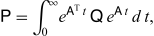
If all eigenvalues of  have negative real parts and
 is a symmetric positive
definite matrix, then the unique solution is the symmetric positive
definite matrix
is a symmetric positive
definite matrix, then the unique solution is the symmetric positive
definite matrix
 |
(3)
|
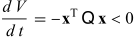
where the exponentials are matrix exponentials. The quadratic form  is a Lyapunov function
for the system
is a Lyapunov function
for the system  ,
since
,
since
 |
(4)
|
for  .
The case
.
The case  gives Lyapunov's first theorem (Boyd 2009).
The solution of  for real matrices is implemented in the Wolfram
Language as LyapunovSolve[a,
c]. For complex matrices, this function
uses the conjugate transpose in place of the
transpose.
for real matrices is implemented in the Wolfram
Language as LyapunovSolve[a,
c]. For complex matrices, this function
uses the conjugate transpose in place of the
transpose.
