


The Lagrange-mesh method approximates a differential operator eigenvalue problem by combining an interpolation vector basis with Gaussian quadrature. Each interpolation function vanishes at all nodes except one. Using the same quadrature for the matrix elements produces a simple discrete eigenvalue problem (Baye and Heenen 1986, Baye et al. 2002).
For a one-dimensional Schrödinger operator, consider
 |
(1)
|
Take  trial functions
 satisfying the boundary
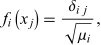
conditions and the nodal conditions
 |
(2)
|
where  are the positive quadrature weights for integration with
respect to
 , and
 is the Kronecker delta.
A weighting function can be absorbed into the
 and the
 . The quadrature approximation
to the Gram matrix is the identity
matrix. With
 , the
derivative term has approximate matrix elements
 |
(3)
|
Multiplication by  is approximated by the diagonal matrix with entries
 , giving
 |
(4)
|
The resulting eigenvalue problem is
 |
(5)
|
This is closely related to discrete variable representation.
For Hermite-Gauss quadrature, let  be the zeros
of the Hermite polynomial
 and let
 be the quadrature weights
for
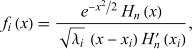
 . An exactly orthonormal vector basis is
 |
(6)
|
where  , and the value at
 is defined by its limit. Its
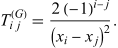
derivative matrix has elements
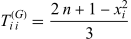 |
(7)
|
and, for  ,
 |
(8)
|
Thus the matrix is symmetric. Trott (2006) uses this type of interpolation vector basis to approximate the quartic oscillator.
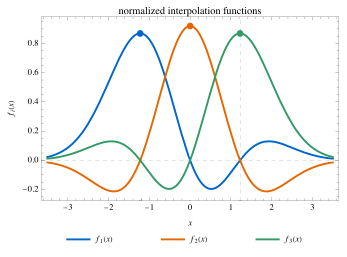
The figure above shows the three interpolation functions for  . Vertical guides mark the nodes
 , 0, and
 . Each function
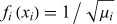
vanishes at the other two nodes. The colored dots mark the nonzero nodal values
 .
Replacing exact integrals by quadrature generally removes the upper-bound property of the Rayleigh-Ritz
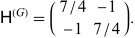
variational technique. For example, the two-node Hermite mesh for  gives
 |
(9)
|
Its lowest eigenvalue is  , below the quartic
oscillator's ground value
 . In contrast,
the Rayleigh-Ritz variational technique
on the same two-dimensional trial subspace with exact
integrals gives the upper bound
 .
