

A discrete variable representation (DVR) expresses a finite-dimensional vector space of functions in a vector basis associated with a set of nodes. It converts between expansion coefficients and weighted values at the nodes, allowing multiplication by a function to be approximated by a diagonal matrix (Light et al. 1985).
One construction uses an  -point Gaussian quadrature
rule for a positive weighting function
 on an interval
 . Let
 be its nodes,
 its Christoffel numbers,
and
 ,
 ,
...,
 the orthogonal polynomials with real coefficients, normalized in the weighted inner
product. The matrix with elements
 |
(1)
|
for  ,
2, ...,
 satisfies
 |
(2)
|
where  is the identity matrix and
 denotes the transpose. This
follows because Gaussian quadrature integrates
each product
 , of polynomial degree
at most
 , exactly. Thus
 is an orthogonal matrix.
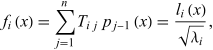
The transformed orthonormal basis consists of
 |
(3)
|
where  are the fundamental Lagrange interpolating
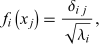
polynomials for the nodes. They satisfy
 |
(4)
|
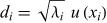
where  is the Kronecker delta. Consequently, if
 ,
its transformed expansion coefficients are
 .
For multiplication by a function  , the quadrature gives
 |
(5)
|
This diagonal matrix is exact whenever the integrands fall within the quadrature's exactness class. For a general  , it is a quadrature approximation to the exact matrix
of multiplication on the trial subspace. The Lagrange-mesh
method uses this representation in approximating differential
operators.
