

A Schrödinger operator is a differential operator consisting of a kinetic-energy term and a multiplication operator given
by a potential. For a particle of mass  moving in
  , it has the form
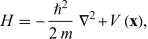 |
on a suitable dense domain in the Hilbert space  . In mathematical treatments,
units are often chosen so that the same operator is written
. In mathematical treatments,
units are often chosen so that the same operator is written  .
.
The stationary Schrödinger equation is the spectral problem
 |
The domain and boundary conditions are part of the definition of  . Conditions on the potential
  are used to ensure that
  is self-adjoint. Self-adjointness
implies that its spectrum is real and that it
generates unitary time evolution. Bound states correspond to square-integrable eigenfunctions,
while scattering states are associated with the continuous spectrum.
is self-adjoint. Self-adjointness
implies that its spectrum is real and that it
generates unitary time evolution. Bound states correspond to square-integrable eigenfunctions,
while scattering states are associated with the continuous spectrum.
The free-particle operator has  . Other important examples include the harmonic oscillator,
Coulomb potentials, periodic potentials, and random potentials.
. Other important examples include the harmonic oscillator,
Coulomb potentials, periodic potentials, and random potentials.
