


The Rayleigh-Ritz variational technique approximates eigenfunctions and eigenvalues by restricting a variational problem to a finite-dimensional trial subspace. For a Sturm-Liouville equation, the variational formulation requires
 |
(1)
|
to have a stationary value subject to the normalization condition
 |
(2)
|
and the boundary conditions
 |
(3)
|
This leads to the Sturm-Liouville equation
 |
(4)
|
which gives the stationary values of
 |
(5)
|
as
 |
(6)
|
where  are the eigenvalues
corresponding to the eigenfunction
 .
For  linearly independent trial functions
 satisfying the homogeneous boundary conditions
 ,
substitute
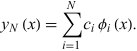 |
(7)
|
The Rayleigh quotient restricted to this subspace gives the generalized eigenvalue problem
 |
(8)
|
where the matrices have elements
 |  | 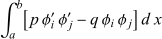 |
(9)
|
 |  |  |
(10)
|
The Gram matrix  is positive definite
when
 . For an orthonormal
basis in the weighted inner product,
 is the identity matrix.
For a regular self-adjoint Sturm-Liouville
equation with
 , the approximate eigenvalues,
ordered increasingly and counted with multiplicity,
are upper bounds on the corresponding exact eigenvalues.
Enlarging a nested trial subspace can only decrease
these upper bounds (Teschl 2009, pp. 118-119). These bounds require the exact
trial-space matrix elements. Replacing them by quadrature
approximations, as in the Lagrange-mesh method,
need not preserve the upper-bound property.
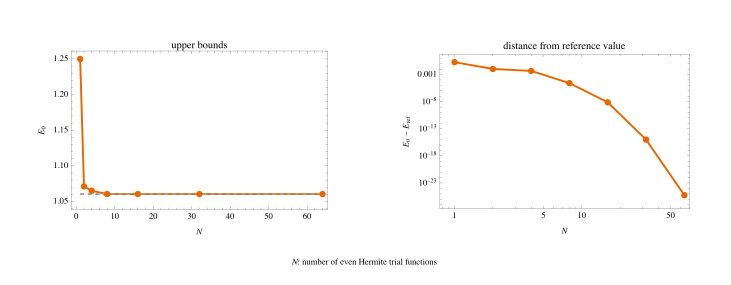
The figure above uses the quartic oscillator and the nested trial subspaces spanned by the first
 even Hermite polynomials multiplied by Gaussian
factors. The left panel shows upper bounds on the lowest eigenvalue.
The right panel shows their distance from the high-precision reference value given
by Trott (2006). The points are computed for
 , 2, 4, 8, 16, 32, and 64.
