


Implicitization is the process of finding implicit equations for a curve or surface
specified by parametric equations. For parameterizations by polynomials
or rational functions over  , the algebraic problem is to find polynomial
equations defining the smallest affine variety
containing the image. This variety
can contain points that the original parameterization
does not reach (Abbott et al. 2017).
For a polynomial parameterization  over a field
 , form the ideal
generated by
 in
 .
Its elimination ideal in
 consists precisely of the polynomials
that vanish identically after substituting the parameterization.
A Gröbner basis for a lexicographic
order placing all parameters before all coordinate
variables computes this ideal.
For example, eliminating the parameter  from
 |  |  |
(1)
|
 |  |  |
(2)
|
where  ,
gives the implicit equation
 |
(3)
|
The parametric equations cover the unit circle except for  ,
which is recovered as a limit as
 . Thus the implicit
equation includes a point missing from the original image.
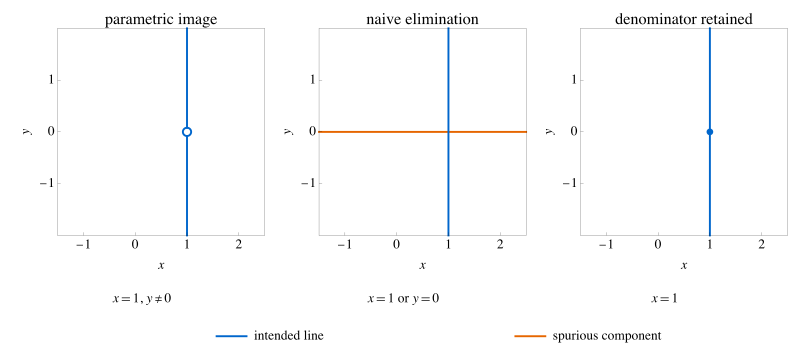
The figure above illustrates how clearing denominators without retaining their nonvanishing conditions can introduce additional points.
For example, the parameterization  ,
 with
 has
 , but the cleared equations
 and
 give
 |
(4)
|
The resultant vanishes on the entire line  as well as on the intended line
 . The Rabinowitsch
trick introduces an auxiliary variable
 with
 to enforce
 . Eliminating
 computes an ideal saturation,
and then eliminating
 leaves
 as the implicit equation. The point
 still belongs to the resulting line
even though it is absent from the parameterization.
Standard algebraic methods use resultants or Gröbner bases (Manocha and Canny 1992, D'Andrea 2001, Abbott et al. 2017). For a canal surface, the equations for the moving sphere and its envelope provide a starting point for eliminating the parameter, as in the construction of a tube around a trefoil knot (Trott 2006). Restrictions on the ranges of real parameters must also be checked separately.
