


An affine variety  is an algebraic variety contained in affine
space. For example,
 |
(1)
|
is the cone, and
 |
(2)
|
is a conic section, which is a subvariety of the cone. The cone can be written
 to indicate that it is
the variety corresponding to
 . Naturally, many other polynomials
vanish on
 .
In fact, the ideal of all polynomials
vanishing on the cone is
 in the polynomial
ring
 .
The ideal of polynomials
vanishing on the conic section is the ideal
radical of the ideal generated by
 and
 . For example, when the plane
is
 , this vanishing ideal
is
 ,
whereas the ideal generated by the two defining equations
is
 .
A morphism between two affine varieties is given by polynomial coordinate functions.
For example, the map  is a morphism
from
 to
 .
Two affine varieties are isomorphic if there is a
morphism which has an inverse morphism.
For example, the affine variety
 is isomorphic
to the cone
 via the coordinate change
 .
Many polynomials  may be factored, for instance
 , and then
 . Consequently, only irreducible
polynomials, and more generally only prime ideals
 are used in the definition of a variety.
An affine variety
 is the set of common zeros of a
collection of polynomials
 , ...,
 , i.e.,
 |
(3)
|
as long as the ideal  is a prime
ideal. More classically, an affine variety is defined by any set
of polynomials, i.e., what is now called an algebraic
set. If the defining prime ideal has ideal
height
 ,
then
 has dimension
 . The number of listed generators alone does not determine
the ideal height or the dimension.
In either case,
 may have singular points such as the origin
in the cone.
A variety of dimension 1 is an algebraic curve, and one of dimension 2 is an algebraic surface. In complex affine space, the nonsingular part of an algebraic curve is a Riemann surface.
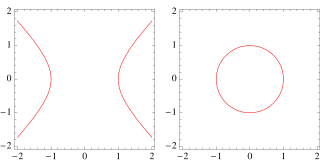
The Wolfram Language function ContourPlot will graph affine varieties in the real affine plane. For example, the following graphs a hyperbola and a circle.
GraphicsGrid[{{
 ContourPlot[x^2 - y^2 == 1, {x, -2, 2}, {y, -2, 2}],
 ContourPlot[x^2 + y^2 == 1, {x, -2, 2}, {y, -2, 2}]
}}]
