


|

|
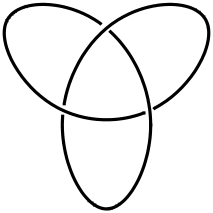
The trefoil knot  , also called the threefoil
knot or overhand knot, is the unique prime knot with
three crossings. It is a (3, 2)-torus knot and has
braid word
 . The trefoil and its
mirror image are not equivalent, as first proved
by Dehn (1914). In other words, the trefoil knot is not amphichiral.
It is, however, invertible, and has Arf
invariant 1.
A trigonometric parameterization of a trefoil knot is
 |  |  |
(1)
|
 |  |  |
(2)
|
 |  |  |
(3)
|
where  . Writing this space curve
as
 , a tube of sufficiently
small radius
 around it is the canal surface
determined by
 |  |  |
(4)
|
 |  |  |
(5)
|
These equations express the moving-sphere construction and the normal-plane condition. They provide a starting point for eliminating  to obtain an implicit polynomial equation
for the tube.
For implicitization, the substitution  converts the center curve
into rational functions,
 |  |  |
(6)
|
 |  |  |
(7)
|
 |  |  |
(8)
|
For a fixed point  , a radius
 , and real
 , the expression
 |
(9)
|
where  , is a polynomial
of polynomial degree at most 12 in
 . The two envelope equations
are equivalent to
 . The resultant
of
 and
 therefore gives a necessary polynomial
condition for the tube at finite
 (Trott 2006). Recovering the intended surface
requires checking for a real common root.
The missing parameter value
 , where
 , must also be treated
in the original envelope equations. These equations
describe a two-dimensional tube surface rather than the
one-dimensional knot itself.
Its laevo form is implemented in the Wolfram Language, as illustrated above, as KnotData["Trefoil"].
M. C. Escher's woodcut "Knots" (Bool et al. 1982, pp. 128 and 325; Forty 2003, Plate 71) depicts three trefoil knots composed of differing types of strands. A preliminary study (Bool et al. 1982, p. 123) depicts another trefoil.
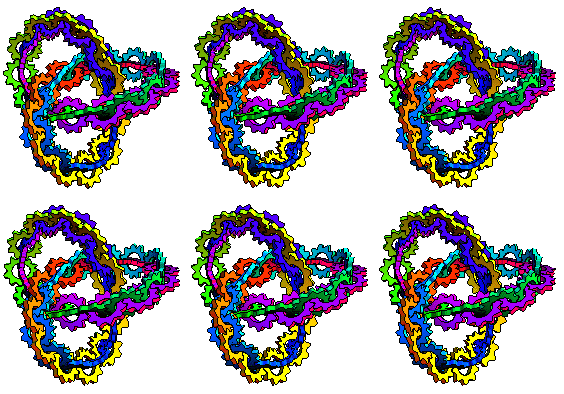
The animation above shows a series of gears arranged along a Möbius strip trefoil knot (M. Trott).
The bracket polynomial can be computed as follows.
 |  |  |
(10)
|
 |  |  |
(11)
|
Plugging in
 |  |  |
(12)
|
 |  |  |
(13)
|
gives
 |
(14)
|
The corresponding Kauffman polynomial X is then given by
 |  |  |
(15)
|
 |  |  |
(16)
|
where the writhe  (Kauffman 1991, p. 35; Livingston 1993, p. 219)
The Alexander polynomial  , BLM/Ho polynomial
 , Conway polynomial
 , HOMFLY polynomial
 , Jones polynomial
 , and Kauffman
polynomial F
 of the trefoil knot are
 |  |  |
(17)
|
 |  |  |
(18)
|
 |  |  |
(19)
|
 |  |  |
(20)
|
 |  |  |
(21)
|
 |  |  |
(22)
|
Here,  corresponds to the right-hand trefoil.
There are no other knots on 10 or fewer crossings sharing the same Alexander polynomial, BLM/Ho polynomial, or Jones polynomial.
The knot group of the trefoil knot is
 |
(23)
|
or equivalently
 |
(24)
|
(Rolfsen 1976, pp. 52 and 61).

 ."
