


A canal surface is the envelope of a one-parameter family of spheres. The centers follow a space curve  , called the spine curve, and the radius
 may vary. For differentiable
 and
 , the envelope equations
 and
 , where
 , give
 |  |  |
(1)
|
 |  |  |
(2)
|
For fixed  with
 , these are a sphere
and a plane perpendicular to the tangent
vector. If
 , they meet
in a nondegenerate circle with center
 and radius
 given by
 |  | 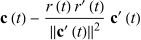 |
(3)
|
 |  | 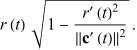 |
(4)
|
This is the characteristic circle of the family. Equality gives a single point, while  gives no real
intersection. The nondegeneracy condition on the circles does not by itself exclude
singularities or self-intersections of the whole envelope.
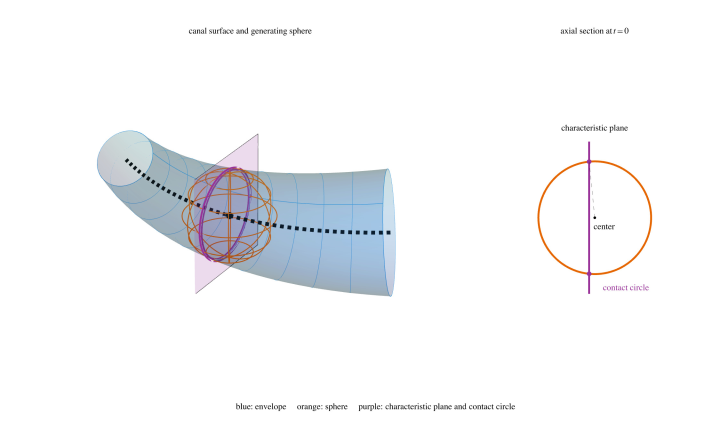
The illustrated family has spine curve and radius
 |  |  |
(5)
|
 |  |  |
(6)
|
where  . At
 , the highlighted sphere
has radius
 , its characteristic plane
is
 , and the contact circle
has radius
 . The right panel shows
their intersection in the plane
 .
For constant radius, the characteristic circles lie in the normal planes of the spine curve and generate a tube. A straight spine gives a circular cylinder, and a circular spine gives a torus. Cyclides admit two such families of spheres.
When the center coordinates and squared radius are rational functions, implicitization
using a resultant to eliminate  gives a polynomial condition
for the envelope. Extraneous factors can occur, so the
resultant alone need not be its defining equation (Dohm
and Zube 2009).
