


The halved folded  -cube graph, for even
 , is obtained by identifying complementary vertices
in a halved cube graph. Equivalently, it is either
halved graph of the folded
cube graph (Chan 2020, p. 772).
Its vertices are pairs  of complementary even-weight vectors in
 . Two distinct pairs are adjacent iff
representatives have Hamming distance 2 or
 . The number of vertices
is
 .
For
 the result is the tetrahedral graph
 . For even
 the vertex degree is
 .
For even  ,
the halved folded
 -cube graph
 has distinct adjacency eigenvalues
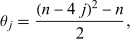 |
(1)
|
where  ranges from 0 through
 and
 is the floor function
(Chan 2020, p. 772). Its least graph eigenvalue
is therefore
 |
(2)
|
and the Hoffman ratio bound gives the chromatic number bounds
 |
(3)
|
where  is the ceiling function. For
 , 8, and 10, these lower bounds are 16, 8, and 16, respectively.
The 6-cube case is the complete graph
 . The 8-cube and 10-cube cases are strongly
regular graphs with parameters
 and
 , respectively. In particular, the 10-cube case
has graph spectrum
 (DistanceRegular.org).
Halved folded cube graphs are distance-regular (Chan 2020, p. 772). Translations by even-weight vectors and permutations of
coordinates act transitively on ordered vertex pairs
at each graph distance, so the graphs are also
distance-transitive. They are Cayley
graphs on the group of even-weight vectors modulo complementation. The two-coordinate
changes generate this group, so the graphs are connected.
Their integer graph eigenvalues make them integral graphs. The graphs are implemented in the
Wolfram Language as GraphData[ "HalvedFoldedCube",
n
 ]
for small even
 .
