

The Hoffman ratio bound, also called the Hoffman bound, is an upper bound on the independence number of a
regular graph in terms of its least graph
eigenvalue. If  is a regular graph of vertex
degree
is a regular graph of vertex
degree  on
on  vertices and has least graph
eigenvalue
vertices and has least graph
eigenvalue  ,
then
,
then
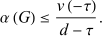 |
(1)
|
If an independent vertex set meets the bound, then every vertex outside the set has exactly  neighbors in it.
Applying the bound to the graph complement gives
the corresponding upper bound on the clique
number. For a strongly regular graph,
the latter bound agrees with the Delsarte bound.
neighbors in it.
Applying the bound to the graph complement gives
the corresponding upper bound on the clique
number. For a strongly regular graph,
the latter bound agrees with the Delsarte bound.
Every color class in a vertex coloring is an independent vertex set, so the chromatic number satisfies
![chi(G)>=[v/(alpha(G))]>=[1-d/tau],](/images/equations/HoffmanRatioBound/NumberedEquation2.svg) |
(2)
|
where ![[x]](/images/equations/HoffmanRatioBound/Inline6.svg) is the ceiling function. For a strongly
regular graph, the least graph eigenvalue
is determined by its common-neighbor parameters.
is the ceiling function. For a strongly
regular graph, the least graph eigenvalue
is determined by its common-neighbor parameters.
More generally, for a simple graph with at least one graph edge, the spectral lower bound on the chromatic number is
![chi(G)>=[1-(theta_(max))/(theta_(min))],](/images/equations/HoffmanRatioBound/NumberedEquation3.svg) |
(3)
|
where  and
and  are the largest and least adjacency eigenvalues
(Brouwer and Haemers 2012). This form does not require the graph
to be regular.
are the largest and least adjacency eigenvalues
(Brouwer and Haemers 2012). This form does not require the graph
to be regular.
The independence-number form of the Hoffman ratio bound is due to A. J. Hoffman, but was not published by him. Lovász (1979, Thm. 9) published a bound
using the Lovász number that implies the
Hoffman ratio bound, and Haemers (2021) gives a historical account. The Hoffman ratio
bound is the  case of the Haemers regular upper bound.
