

The quantum chromatic number  of a graph
  is a quantum analog of the chromatic
number. It is the minimum number
is a quantum analog of the chromatic
number. It is the minimum number  of colors for which two separated players can win the
  -coloring
game on
-coloring
game on  with certainty using an entangled strategy. In this game, the players are given vertices
 and
and  of
of  which are promised to be equal or adjacent.
They must return colors that agree when
which are promised to be equal or adjacent.
They must return colors that agree when  and differ when
  and
and  are adjacent (Cameron et al. 2007).
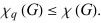
Classical deterministic strategies for the coloring game are equivalent to ordinary vertex colorings, and therefore
 |
(1)
|
Quantum 2-colorability is exactly the property of being bipartite. Thus a non-bipartite graph satisfies  , and hence
  whenever
  .
.
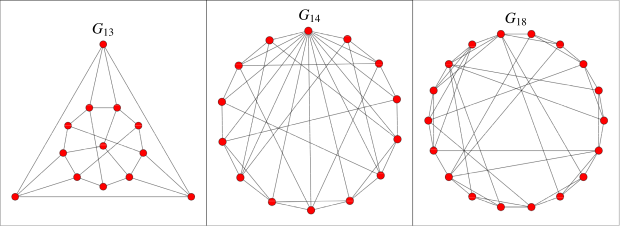
The inequality can be strict. Mančinska and Roberson (2016) considered a 13-vertex Mančinska-Roberson graph  that is the orthogonality graph of the nonzero vectors
in
that is the orthogonality graph of the nonzero vectors
in  modulo overall sign. This graph is also the Yu-Oh 13-ray graph used in state-independent
Kochen-Specker contextuality (Yu and Oh 2012, Cabello et al. 2016). Adding
an apex vertex to
modulo overall sign. This graph is also the Yu-Oh 13-ray graph used in state-independent
Kochen-Specker contextuality (Yu and Oh 2012, Cabello et al. 2016). Adding
an apex vertex to  gives a 14-vertex Mančinska-Roberson
graph
gives a 14-vertex Mančinska-Roberson
graph  with
with  and
and  (Mančinska and Roberson 2016). Cameron et al. (2007) previously gave
the 18-vertex Cameron-Montanaro-Newman-Severini-Winter
graph
(Mančinska and Roberson 2016). Cameron et al. (2007) previously gave
the 18-vertex Cameron-Montanaro-Newman-Severini-Winter
graph  with the same separation. Lalonde (2025) proved that
  is the smallest possible separation between
  and
and  , measured by number of vertices, and in particular that
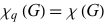 for every graph
  with at most 13 vertices, and also for 14-vertex graphs with
 .
.
Let  be the graph on
  in which two vectors are
adjacent when their Hamming
distance is 2. Here
in which two vectors are
adjacent when their Hamming
distance is 2. Here  is the notation of Luo et al. (2026) for the disjoint union of two copies of the
  -halved cube graph. Using
symmetric balanced incomplete block designs, Luo
et al. (2026) obtained the following values, respectively, when
-halved cube graph. Using
symmetric balanced incomplete block designs, Luo
et al. (2026) obtained the following values, respectively, when  is a prime power satisfying
 ,
when
,
when  is a positive integer, and when
  and
and  are odd prime powers:
 |  |  |
(2)
|
 |  |  |
(3)
|
 |  |  |
(4)
|
Equivalently,  for each of these three families of
  , where
  denotes the
  -halved cube graph.
There are also variants such as the approximate and commuting quantum chromatic numbers, usually denoted  and
and  , for which
 |
(5)
|
(Paulsen and Todorov 2015, Lalonde 2025).
Algorithmically, Paulsen et al. (2016) described a semidefinite programming hierarchy converging to  , while Gribling et al. (2018) placed quantum
graph parameters in a tracial noncommutative polynomial optimization framework, i.e.,
one based on traces of polynomial expressions in noncommuting operator variables,
and gave Lasserre-type semidefinite programming
hierarchies converging to the commuting quantum chromatic number. For small graphs,
Lalonde (2025) also used a recursive obstruction method for proving nonexistence
of low-dimensional orthogonal representations in cases where semidefinite
programming bounds alone were insufficient.
, while Gribling et al. (2018) placed quantum
graph parameters in a tracial noncommutative polynomial optimization framework, i.e.,
one based on traces of polynomial expressions in noncommuting operator variables,
and gave Lasserre-type semidefinite programming
hierarchies converging to the commuting quantum chromatic number. For small graphs,
Lalonde (2025) also used a recursive obstruction method for proving nonexistence
of low-dimensional orthogonal representations in cases where semidefinite
programming bounds alone were insufficient.
The rank- quantum chromatic number
  further requires all measurement projectors in
a quantum coloring to have rank exactly
further requires all measurement projectors in
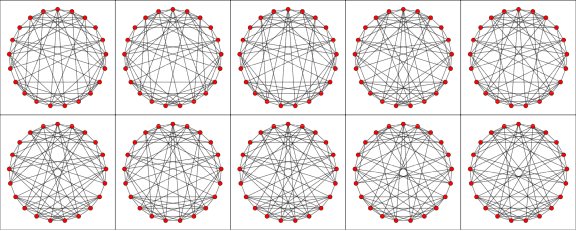
a quantum coloring to have rank exactly  . Lalonde (2025) gave the 21-vertex Lalonde
graph
. Lalonde (2025) gave the 21-vertex Lalonde
graph  with
with
 |
(6)
|
and
 |
(7)
|
where  denotes orthogonal rank. This graph is illustrated
above in a number of bilaterally symmetric embeddings and gives the first provable
separation between the rank-1 and rank-2 quantum chromatic numbers.
denotes orthogonal rank. This graph is illustrated
above in a number of bilaterally symmetric embeddings and gives the first provable
separation between the rank-1 and rank-2 quantum chromatic numbers.
