

The Erdős-Graham binomial divisor problem asks whether there is a positive constant  such that every binomial
coefficient
such that every binomial
coefficient  with
with  has a divisor
  satisfying
  (Erdős and Graham 1976). Since
 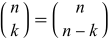 , it is enough to consider
  . The question is problem 387
in the Erdős problems collection (Bloom 2026).
. The question is problem 387
in the Erdős problems collection (Bloom 2026).
Bui et al. (2026) refuted the conjecture in general while proving a strong positive result when  is sufficiently large. For every sufficiently small
  and all sufficiently large
  , if
, if
 |
then  has a divisor in the interval
 ![(n-n/(lnn)^(1/4),n]](/images/equations/Erdos-GrahamBinomialDivisorProblem/Inline12.svg) .
In the other direction, for every sufficiently large fixed
.
In the other direction, for every sufficiently large fixed  and sufficiently small
  , there are infinitely many ordered
pairs
, there are infinitely many ordered
pairs  with
with
 |
for which  has no divisor in the interval
 ![(241nlnlnk/lnk,n]](/images/equations/Erdos-GrahamBinomialDivisorProblem/Inline17.svg) . The latter result rules out a universal positive constant
. The latter result rules out a universal positive constant  .
.
The main ideas in the proof of an intermediate covering theorem were developed by the authors in interactive sessions with ChatGPT 5.5 Pro (Bui et al. 2026).

 ." Fibonacci Quart. 14, 348-352, 1976.