


The Erdős unit distance problem asks to determine the maximum number  of occurrences of the same distance
among
 points in the plane. It is equivalent
to finding a maximally dense unit-distance
graph on
 vertices. The conjectured matching upper
bound for
 is problem 90 in the Erdős
problems collection (Bloom 2026).
Erdős (1946) proved a lower bound of  , where
 is big-Omega notation,
and he offered a $500 prize for a matching upper bound.
The conjectured matching bound, in the form
 , where
 denotes a quantity tending to 0 in little-O
notation, or more concretely
 for some absolute constant
 , was refuted by an OpenAI-generated proof
(Alon et al. 2026, OpenAI 2026b). The proof constructs
point sets for infinitely many
 with at least
 unit-distance pairs
for some fixed
 . Sawin (2026) subsequently made the bound explicit
and proved that, for arbitrarily large
 , more than
 unit-distance pairs occur.
The construction uses algebraic number fields, infinite
class field towers, and the Golod-Shafarevich
theorem, and gives an asymptotic counterexample to square
grid optimality.
Lee et al. (2026) proved a robust version of this phenomenon. For every positive integer  , they constructed a set
 of
 points such that every subset
 with at least two points has some distance
occurring at least
 times, for absolute constants
 . Taking
 and rescaling gives another counterexample to the unit-distance conjecture.
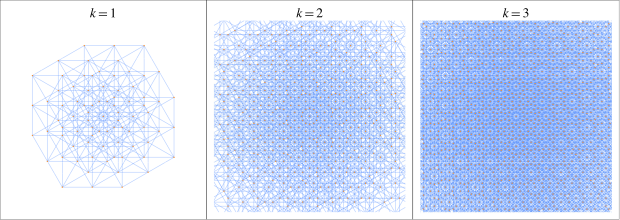
Finite pieces of the explicit construction are illustrated above. They are obtained by taking  and points
 with
 ,
then joining pairs at unit distance (S. Yang, in
Pegg 2026). The case
 has 625 vertices and 2800
edges, giving graph density
14/975 and edge count per vertex
112/25. Increasing
 reduces boundary effects in these finite
pieces, but this box family still has only linearly many unit-distance
pairs in the number of vertices (so the parameter
 in the illustration is not the asymptotic parameter in Sawin's proof).
In Sawin's asymptotic construction, arbitrarily large
 comes from number fields of
increasing degree, giving higher-dimensional lattices
with many vectors whose projections have length 1.
For the finite box graph with  ,
exact coordinates and NumberFieldDiscriminant[x]
show that the points generate number
fields whose discriminants are supported only
at the primes 2 and 3. Applying the same check to
the exact coordinates of Heule graphs and Parts
graphs instead brings in the primes 3, 5, and
11 (E. Pegg, pers. comm., May 22, 2026).
However, the true order of  remains unknown. The best independently established upper bound is
 , where
 is big-O notation (Szemerédi
2016). In particular, the OpenAI construction gives an infinite family of point sets beating the conjectured grid-type asymptotic bound, but
does not give a matching upper bound or characterize extremal configurations.
Exact values of  for
 were obtained by Schade (1993) together with the complete
sets of densest graphs for
 .
Agoston and Pálvőlgyi (2022) subsequently determined the exact value
of
 ,
and Alexeev et al. (2025) found
 for
 as well as a complete set of
densest graphs. All but one of these graphs
(one of the 7 on 17 vertices whose unit-distance
embedding does not reside within the Moser ring) were previously discovered by Engel
et al. (2024).
For  ,
2, ...,
 is given by 0, 1, 3, 5, 7, 9, 12, 14, 18, 20, 23, 27, 30, 33, 37, 41, 43, 46, 50,
54, 57, ... (OEIS A186705). The corresponding
numbers of nonisomorphic maximally dense unit-distance graphs are 1, 1, 1, 1, 1, 4, 1, 3, 1, 1, 2, 1, 1, 2, 1, 1,
7, 16, 3, 1, 5, ... (OEIS A385657; Alexeev
et al. 2025).

 Points." Amer. Math. Monthly 53, 248-250,
1946.Lee, S.; Pohoata, C.; and Zhu, D. G. "The Minkowski Grid
Has Robustly Many Repeated Distances." 6 July 2026.
 Pegg, E. Jr. "OpenAI Disproves Erdős Unit Distance Conjecture."
Wolfram Community, May 21, 2026.