

A critical catenoid is the compact portion of a catenoid which, after scaling, is the free
boundary minimal surface in the unit ball  having rotational symmetry
(Fraser and Schoen 2016). It has the topology of an
annulus, its boundary lies
on the sphere
having rotational symmetry
(Fraser and Schoen 2016). It has the topology of an
annulus, its boundary lies
on the sphere  , and it meets this sphere orthogonally.
Let  be the unique positive fixed point of the hyperbolic
cotangent, so
be the unique positive fixed point of the hyperbolic
cotangent, so
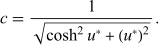 |
(1)
|
 |
(2)
|
(OEIS A085984). Then a set of parametric equations for the critical catenoid is
 |  |  |
(3)
|
 |  |  |
(4)
|
 |  |  |
(5)
|
where  ,
,
 ,
and
,
and
 |
(6)
|
The value of  puts the two boundary circles
on the unit sphere, while the equation
puts the two boundary circles
on the unit sphere, while the equation  is exactly the condition that the catenoid
meet the unit sphere orthogonally.
is exactly the condition that the catenoid
meet the unit sphere orthogonally.
In the equal-ring boundary value problem, the name critical catenoid is also used for the limiting catenoid
spanning two equal coaxial circles of radius  whose planes
are separated by the greatest possible distance
whose planes
are separated by the greatest possible distance  (Anderson 2026). The two formulations
are different boundary value problems. Nevertheless,
their normalizations give homothetic portions of the
same catenoid, since the limiting condition is again
(Anderson 2026). The two formulations
are different boundary value problems. Nevertheless,
their normalizations give homothetic portions of the
same catenoid, since the limiting condition is again
 .
In terms of the Laplace limit
.
In terms of the Laplace limit  (OEIS A033259),
the limiting ratio is
(OEIS A033259),
the limiting ratio is
 |
(7)
|
The solid of revolution bounded by this catenoid and the two planar disks has volume
 |
(8)
|
which is half the volume of the circumscribing right circular cylinder. The half-cylinder identity was found by Plateau and published by Lindelöf (Lindelöf 1863, p. 364; Plateau 1873, §§89-90). Anderson (2026) proved that the identity holds only at the limiting parameter and that the normalized volume decreases strictly through this value.
