


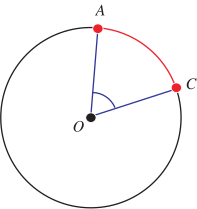
A circular arc, usually called simply an arc in plane geometry, is either of the two connected portions of the circumference of a circle
determined by two distinct points on it. The circular arc
corresponding to the central angle  is denoted
  . Similarly, the size of the central
angle subtended by this arc, i.e., the measure of the arc, is sometimes (e.g.,
Rhoad et al. 1984, p. 421) but not always (e.g., Jurgensen 1963) denoted
. Similarly, the size of the central
angle subtended by this arc, i.e., the measure of the arc, is sometimes (e.g.,
Rhoad et al. 1984, p. 421) but not always (e.g., Jurgensen 1963) denoted
 .
.
The center of a circular arc is the center of the circle of which it is a part. A circular arc subtending
a central angle of  is a quarter circle.
A circular arc whose endpoints lie on a diameter of
a circle is a semicircle.
Together with its diameter, a semicircle
bounds a half-disk; together with two perpendicular
radii, a quarter circle
bounds a quarter-disk.
is a quarter circle.
A circular arc whose endpoints lie on a diameter of
a circle is a semicircle.
Together with its diameter, a semicircle
bounds a half-disk; together with two perpendicular
radii, a quarter circle
bounds a quarter-disk.
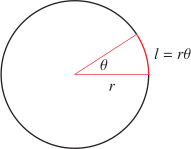
For a circle of radius  , the arc length
  subtended by a central
angle
subtended by a central
angle  is proportional to
  .
If
.
If  is measured in radians,
then the constant of proportionality is 1, so
is measured in radians,
then the constant of proportionality is 1, so
 |
(1)
|
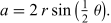
The length of the chord connecting the arc's endpoints is
 |
(2)
|
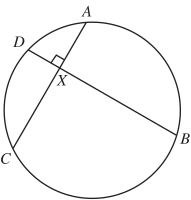
As Archimedes proved, for chords  and
and  which are perpendicular
to each other,
which are perpendicular
to each other,
 |
(3)
|
(Wells 1991).
