


The constant pi, denoted  ,
is a real number defined as the ratio of a circle's
circumference
,
is a real number defined as the ratio of a circle's
circumference  to its diameter
  ,
,
 |  |  |
(1)
|
 |  |  |
(2)
|

 has decimal expansion given by
 |
(3)
|
(OEIS A000796). Pi's digits have many interesting properties, although not very much is known about
their analytic properties. However, spigot (Rabinowitz
and Wagon 1995, Arndt and Haenel 2001, Borwein and Bailey 2003, pp. 140-141)
and digit-extraction algorithms (the
BBP formula) are known for  .
.
A brief history of notation for pi is given by Castellanos (1988ab).  is sometimes known as Archimedes' constant
or Ludolph's constant after Ludolph van Ceulen (1539-1610), a Dutch
is sometimes known as Archimedes' constant
or Ludolph's constant after Ludolph van Ceulen (1539-1610), a Dutch  calculator. The symbol
  was first used by Welsh mathematician William Jones in 1706,
and subsequently adopted by Euler.
was first used by Welsh mathematician William Jones in 1706,
and subsequently adopted by Euler.

In Measurement of a Circle, Archimedes (ca. 225 BC) obtained the first rigorous approximation by inscribing and circumscribing  -gons on a circle
using the Archimedes algorithm. Using
-gons on a circle
using the Archimedes algorithm. Using  (a 96-gon), Archimedes obtained
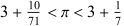 |
(4)
|
(Wells 1986, p. 49, Shanks 1993, p. 140, Borwein et al. 2004, pp. 1-3).
 is known to be irrational
(Lambert 1761, Legendre 1794, Hermite 1873, Nagell 1951, Niven 1956, Struik 1969,
Königsberger 1990, Schröder 1993, Stevens 1999, Borwein and Bailey 2003,
pp. 139-140). In 1794, Legendre also proved that
is known to be irrational
(Lambert 1761, Legendre 1794, Hermite 1873, Nagell 1951, Niven 1956, Struik 1969,
Königsberger 1990, Schröder 1993, Stevens 1999, Borwein and Bailey 2003,
pp. 139-140). In 1794, Legendre also proved that  is irrational (Wells
1986, p. 76).
is irrational (Wells
1986, p. 76).  is also transcendental (Lindemann 1882).
An immediate consequence of Lindemann's proof of the transcendence of
is also transcendental (Lindemann 1882).
An immediate consequence of Lindemann's proof of the transcendence of  also proved that the geometric
problem of antiquity known as circle squaring
is impossible. A simplified, but still difficult, version of Lindemann's proof is
given by Klein (1955).
also proved that the geometric
problem of antiquity known as circle squaring
is impossible. A simplified, but still difficult, version of Lindemann's proof is
given by Klein (1955).
It is also known that  is not a Liouville number (Mahler 1953), but
it is not known if
is not a Liouville number (Mahler 1953), but
it is not known if  is normal to any base (Stoneham 1970). The following table summarizes progress in
computing upper bounds on the irrationality
measure for
is normal to any base (Stoneham 1970). The following table summarizes progress in
computing upper bounds on the irrationality
measure for  .
It is likely that the exponent can be reduced to
.
It is likely that the exponent can be reduced to  , where
  is an infinitesimally small number (Borwein et al.
1989).
is an infinitesimally small number (Borwein et al.
1989).
| upper bound | reference |
| 20 | Mahler (1953), Le Lionnais (1983, p. 50) |
| 14.65 | Chudnovsky and Chudnovsky (1984) |
| 8.0161 | Hata (1992) |
| 7.606308 | Salikhov (2008) |
| 7.10320534 | Zeilberger and Zudilin (2020) |
It is not known if  ,
,
 , or
, or  are irrational. However,
it is known that they cannot satisfy any polynomial
equation of degree
are irrational. However,
it is known that they cannot satisfy any polynomial
equation of degree  with integer coefficients
of average size
with integer coefficients
of average size  (Bailey 1988ab, Borwein et al. 1989).
J. H. Conway has shown that there is a sequence of fewer than 40 fractions  ,
,  , ... with the property that if you start with
  and repeatedly multiply by the first of the
  that gives an integer result until a power
of 2 (say,
that gives an integer result until a power
of 2 (say,  ) occurs, then
  is the
  th
decimal digit of
th
decimal digit of  .
.
 crops up in all sorts of unexpected
places in mathematics besides circles and spheres.
For example, it occurs in the normalization of the normal
distribution, in the distribution of primes,
in the construction of numbers which are very close to integers
(the Ramanujan constant), and in the probability
that a pin dropped on a set of parallel lines intersects
a line (Buffon's needle problem). Pi also
appears as the average ratio of the actual length and the direct distance between
source and mouth in a meandering river (Stølum 1996, Singh 1997).
crops up in all sorts of unexpected
places in mathematics besides circles and spheres.
For example, it occurs in the normalization of the normal
distribution, in the distribution of primes,
in the construction of numbers which are very close to integers
(the Ramanujan constant), and in the probability
that a pin dropped on a set of parallel lines intersects
a line (Buffon's needle problem). Pi also
appears as the average ratio of the actual length and the direct distance between
source and mouth in a meandering river (Stølum 1996, Singh 1997).
The Bible contains two references (I Kings 7:23 and Chronicles 4:2) which give a value of 3 for  (Wells 1986, p. 48). It should be mentioned, however, that both instances refer
to a value obtained from physical measurements and, as such, are probably well within
the bounds of experimental uncertainty. I Kings 7:23 states, "Also he made a
molten sea of ten cubits from brim to brim, round in compass, and five cubits in
height thereof; and a line thirty cubits did compass it round about." This implies
(Wells 1986, p. 48). It should be mentioned, however, that both instances refer
to a value obtained from physical measurements and, as such, are probably well within
the bounds of experimental uncertainty. I Kings 7:23 states, "Also he made a
molten sea of ten cubits from brim to brim, round in compass, and five cubits in
height thereof; and a line thirty cubits did compass it round about." This implies
 .
.

The Babylonians gave an estimate of  as
as  ,
while the Egyptians gave
,
while the Egyptians gave  in the Rhind papyrus and 22/7 elsewhere. Old Babylonian tablets also used circular
figures such as the grain figure in area
calculations. In third-century China, Liu
Hui's exhaustion method successively doubled inscribed regular
polygons to bound
in the Rhind papyrus and 22/7 elsewhere. Old Babylonian tablets also used circular
figures such as the grain figure in area
calculations. In third-century China, Liu
Hui's exhaustion method successively doubled inscribed regular
polygons to bound  and recommend the pi approximation
  (Dauben 2007).
 appeared in Alfred Hitchcock's insipid
and poorly acted 1966 film Torn Curtain, including in one particularly strange
but memorable scene where Paul Newman (Professor Michael Armstrong) draws a
appeared in Alfred Hitchcock's insipid
and poorly acted 1966 film Torn Curtain, including in one particularly strange
but memorable scene where Paul Newman (Professor Michael Armstrong) draws a  symbol in the dirt with his foot at
the door of a farmhouse. In this film, the symbol
symbol in the dirt with his foot at
the door of a farmhouse. In this film, the symbol  is the pass-sign of an underground East German network that
smuggles fugitives to the West.
is the pass-sign of an underground East German network that
smuggles fugitives to the West.
The 1998 film Pi is a dark, strange, and hyperkinetic movie about a mathematician who is slowly going
insane searching for a pattern to the Stock Market. Both a Hasidic cabalistic sect
and a Wall Street firm learn of his investigation and attempt to seduce him. Unfortunately,
the film has essentially nothing to do with real mathematics. 314159, the first six
digits of  , is the combination to Ellie's office
safe in the novel Contact
by Carl Sagan.
, is the combination to Ellie's office
safe in the novel Contact
by Carl Sagan.
On Sept. 15, 2005, Google offered exactly 14159265 shares of Class A stock, which is the same as the first eight digits or  after the decimal point (Markoff 2005).
The formula for the volume of a cylinder leads to the mathematical joke: "What is the volume of a pizza of thickness  and radius
  ?"
Answer: pi z z a. This result is sometimes known as the second pizza
theorem.
?"
Answer: pi z z a. This result is sometimes known as the second pizza
theorem.
The 2005 album Aerial features a song called "Pi" in which the first digits of  are interspersed (unfortunately incorrectly) with lyrics.
There are many, many formulas for pi, from the simple to the very complicated.
Ramanujan (1913-1914) and Olds (1963) give geometric constructions for 355/113. Gardner (1966, pp. 92-93) gives a geometric construction for  . Dixon (1991) gives constructions for
 and
and ![sqrt(4+[3-tan(30 degrees)]^2)=3.141533...](/images/equations/Pi/Inline57.svg) . Constructions for
approximations of
. Constructions for
approximations of  are approximations to circle squaring (which is
itself impossible).
are approximations to circle squaring (which is
itself impossible).

 , Revisited." Amer. Math. Monthly 104,
351-353, 1997.Almkvist, G. and Berndt, B. "Gauss, Landen, Ramanujan,
and Arithmetic-Geometric Mean, Ellipses,
, Revisited." Amer. Math. Monthly 104,
351-353, 1997.Almkvist, G. and Berndt, B. "Gauss, Landen, Ramanujan,
and Arithmetic-Geometric Mean, Ellipses,  , and the Ladies Diary." Amer. Math. Monthly 95,
585-608, 1988.Arndt, J. "Cryptic Pi Related Formulas."
, and the Ladies Diary." Amer. Math. Monthly 95,
585-608, 1988.Arndt, J. "Cryptic Pi Related Formulas."  ,
,  , and Euler's Constant." Math. Comput. 50,
275-281, 1988a.Bailey, D. H. "The Computation of
, and Euler's Constant." Math. Comput. 50,
275-281, 1988a.Bailey, D. H. "The Computation of  to
to  Decimal Digits Using Borweins' Quartically Convergent Algorithm." Math. Comput. 50,
283-296, 1988b.Bailey, D. H.; Borwein, P. B.; and Plouffe,
S. "On the Rapid Computation of Various Polylogarithmic Constants." Math.
Comput. 66, 903-913, 1997.Ball, W. W. R. and Coxeter,
H. S. M.
Decimal Digits Using Borweins' Quartically Convergent Algorithm." Math. Comput. 50,
283-296, 1988b.Bailey, D. H.; Borwein, P. B.; and Plouffe,
S. "On the Rapid Computation of Various Polylogarithmic Constants." Math.
Comput. 66, 903-913, 1997.Ball, W. W. R. and Coxeter,
H. S. M.  Beck, G. and Trott, M. "Calculating Pi from Antiquity to Modern Times."
 ."
Indian J. Math. 51, 147-160, 1987b.Borwein, J. M.
and Borwein, P. B. "More Ramanujan-Type Series for
."
Indian J. Math. 51, 147-160, 1987b.Borwein, J. M.
and Borwein, P. B. "More Ramanujan-Type Series for  ." In
." In  ." J. Comput. Appl. Math. 46,
281-290, 1993.Borwein, J. M.; Borwein, P. B.; and Bailey,
D. H. "Ramanujan, Modular Equations, and Approximations to Pi, or How to
Compute One Billion Digits of Pi." Amer. Math. Monthly 96, 201-219,
1989.Borwein, P. B. "Pi and Other Constants."
." J. Comput. Appl. Math. 46,
281-290, 1993.Borwein, J. M.; Borwein, P. B.; and Bailey,
D. H. "Ramanujan, Modular Equations, and Approximations to Pi, or How to
Compute One Billion Digits of Pi." Amer. Math. Monthly 96, 201-219,
1989.Borwein, P. B. "Pi and Other Constants."  ."
Math. Comput. 25, 387-392, 1971.Chudnovsky, D. V.
and Chudnovsky, G. V. Padé and Rational Approximations to Systems
of Functions and Their Arithmetic Applications. Berlin, Germany: Springer-Verlag,
1984.Chudnovsky, D. V. and Chudnovsky, G. V. "Approximations
and Complex Multiplication According to Ramanujan." In
."
Math. Comput. 25, 387-392, 1971.Chudnovsky, D. V.
and Chudnovsky, G. V. Padé and Rational Approximations to Systems
of Functions and Their Arithmetic Applications. Berlin, Germany: Springer-Verlag,
1984.Chudnovsky, D. V. and Chudnovsky, G. V. "Approximations
and Complex Multiplication According to Ramanujan." In  ." In
." In  )." §4.3 in
  Page."
  and the Derived Decimal Approximation. Stanford, CA:
Artificial Intelligence Laboratory, Stanford University, Oct. 1975. Reviewed
in Math. Comput. 31, 1044, 1977.Gourdon, X. and Sebah,
P. "The Constant
and the Derived Decimal Approximation. Stanford, CA:
Artificial Intelligence Laboratory, Stanford University, Oct. 1975. Reviewed
in Math. Comput. 31, 1044, 1977.Gourdon, X. and Sebah,
P. "The Constant  ."
."
 and
and  ." Proc. Japan. Acad. Ser. A Math. Sci. 68,
283-286, 1992.Havermann, H. "
." Proc. Japan. Acad. Ser. A Math. Sci. 68,
283-286, 1992.Havermann, H. " Terms of the Continued Fraction Expansion of Pi."
 ." Amer. Math. Monthly 104, 439-443, 1997.Lambert,
J. H. "Mémoire sur quelques propriétés remarquables
des quantités transcendantes circulaires et logarithmiques." Mémoires
de l'Academie des sciences de Berlin 17, 265-322, 1761.Legendre,
A. M. Eléments de géométrie. Paris, France: Didot,
1794.Le Lionnais, F.
." Amer. Math. Monthly 104, 439-443, 1997.Lambert,
J. H. "Mémoire sur quelques propriétés remarquables
des quantités transcendantes circulaires et logarithmiques." Mémoires
de l'Academie des sciences de Berlin 17, 265-322, 1761.Legendre,
A. M. Eléments de géométrie. Paris, France: Didot,
1794.Le Lionnais, F.  ."
Math. Ann. 20, 213-225, 1882.Lopez, A. "Indiana Bill
Sets the Value of
."
Math. Ann. 20, 213-225, 1882.Lopez, A. "Indiana Bill
Sets the Value of  to 3."
  ."
Nederl. Akad. Wetensch. Proc. Ser. A. 56/Indagationes Math. 15,
30-42, 1953.Markoff, J. "14,159,265 New Slices of Rich Technology."
The New York Times. Aug. 19, 2005.MathPages. "Rounding
Up to Pi."
."
Nederl. Akad. Wetensch. Proc. Ser. A. 56/Indagationes Math. 15,
30-42, 1953.Markoff, J. "14,159,265 New Slices of Rich Technology."
The New York Times. Aug. 19, 2005.MathPages. "Rounding
Up to Pi."  and
and  ."
§13 in
."
§13 in  Is Irrational." Bull. Amer. Math. Soc. 53, 509, 1947.Niven,
I. M.
Is Irrational." Bull. Amer. Math. Soc. 53, 509, 1947.Niven,
I. M.  ."
."

 Page."
  ." Amer. Math. Monthly 102, 195-203, 1995.Ramanujan,
S. "Modular Equations and Approximations to
." Amer. Math. Monthly 102, 195-203, 1995.Ramanujan,
S. "Modular Equations and Approximations to  ." Quart. J. Pure. Appl. Math. 45, 350-372,
1913-1914.Rivera, C. "Problems & Puzzles: Puzzle 050-The Best
Approximation to Pi with Primes."
." Quart. J. Pure. Appl. Math. 45, 350-372,
1913-1914.Rivera, C. "Problems & Puzzles: Puzzle 050-The Best
Approximation to Pi with Primes."  ." Usp. Mat. Nauk 63,
163-164, 2008. English transl. in Russ. Math. Surv 63, 570-572, 2008.Schröder,
E. M. "Zur Irrationalität von
." Usp. Mat. Nauk 63,
163-164, 2008. English transl. in Russ. Math. Surv 63, 570-572, 2008.Schröder,
E. M. "Zur Irrationalität von  und
und  ."
Mitt. Math. Ges. Hamburg 13, 249, 1993.Shanks, D. "Dihedral
Quartic Approximations and Series for
."
Mitt. Math. Ges. Hamburg 13, 249, 1993.Shanks, D. "Dihedral
Quartic Approximations and Series for  ." J. Number. Th. 14, 397-423, 1982.Shanks,
D.
." J. Number. Th. 14, 397-423, 1982.Shanks,
D.  ." Ch. 9 in
  ."
Mitt. Math. Ges. Hamburg 18, 151-158, 1999.Stølum,
H.-H. "River Meandering as a Self-Organization Process." Science 271,
1710-1713, 1996.Stoneham, R. "A General Arithmetic Construction
of Transcendental Non-Liouville Normal Numbers from Rational Functions." Acta
Arith. 16, 239-253, 1970.Stoschek, E. "Modul 33: Algames
with Numbers."
."
Mitt. Math. Ges. Hamburg 18, 151-158, 1999.Stølum,
H.-H. "River Meandering as a Self-Organization Process." Science 271,
1710-1713, 1996.Stoneham, R. "A General Arithmetic Construction
of Transcendental Non-Liouville Normal Numbers from Rational Functions." Acta
Arith. 16, 239-253, 1970.Stoschek, E. "Modul 33: Algames
with Numbers."  Normal?" Math. Intel. 7,
65-67, 1985.Wells, D.
Normal?" Math. Intel. 7,
65-67, 1985.Wells, D.  )."
)."  Is at Most 7.103205334137...." 8 Jan 2020.