


The constant  is base of the natural logarithm.
 is sometimes known as Napier's constant,
although its symbol (
is sometimes known as Napier's constant,
although its symbol ( )
honors Euler.
)
honors Euler.
 is the unique number with the property
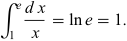
that the area of the region bounded by the hyperbola
is the unique number with the property
that the area of the region bounded by the hyperbola  , the x-axis,
and the vertical lines
, the x-axis,
and the vertical lines  and
and  is 1. In other words,
 |
(1)
|
With the possible exception of  ,
,
 is the most important constant in mathematics
since it appears in myriad mathematical contexts involving limits
and derivatives. The numerical value of
is the most important constant in mathematics
since it appears in myriad mathematical contexts involving limits
and derivatives. The numerical value of  is
is
 |
(2)
|
(OEIS A001113).

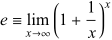
 can be defined by the limit
 |
(3)
|
(illustrated above), or by the infinite series
 |
(4)
|
as first published by Newton (1669; reprinted in Whiteside 1968, p. 225).
 is given by the unusual limit
![lim_(n->infty)[((n+1)^(n+1))/(n^n)-(n^n)/((n-1)^(n-1))]=e](/images/equations/e/NumberedEquation5.svg) |
(5)
|
(Brothers and Knox 1998).
Euler (1737; Sandifer 2006) proved that  is irrational by proving
that
is irrational by proving
that  has an infinite simple continued fraction
(
has an infinite simple continued fraction
(![e=[2,1,2,1,1,4,1,1,6,...]](/images/equations/e/Inline15.svg) ; Nagell 1951),
and Liouville proved in 1844 that
; Nagell 1951),
and Liouville proved in 1844 that  does not satisfy any quadratic equation with
integral coefficients (i.e., if it is algebraic,
it must be algebraic of degree greater than 2). Hermite subsequently settled the
issue, proving
does not satisfy any quadratic equation with
integral coefficients (i.e., if it is algebraic,
it must be algebraic of degree greater than 2). Hermite subsequently settled the
issue, proving  to be transcendental in 1873. However,
  is the "least" transcendental
possible, with irrationality measure
is the "least" transcendental
possible, with irrationality measure  .
.
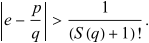
Sondow (2006) proved that  is irrational using a construction for
  as the intersection of a nested sequence of closed intervals.
This method also provides a measure of irrationality in terms of the Smarandache
function (denoted here as
as the intersection of a nested sequence of closed intervals.
This method also provides a measure of irrationality in terms of the Smarandache
function (denoted here as  instead of the conventional
  in order to avoid confusion with the irrationality
measure) by showing that if
in order to avoid confusion with the irrationality
measure) by showing that if  and
and  are any integers with
  , then
 |
(6)
|
It is not known if  or
or  is irrational.
It is known that
is irrational.
It is known that  and
and  do not satisfy any polynomial
equation of degree
do not satisfy any polynomial
equation of degree  with integer coefficients
of average size
with integer coefficients
of average size  (Bailey 1988, Borwein et al. 1989), but it is not known if either of these
is transcendental.
(Bailey 1988, Borwein et al. 1989), but it is not known if either of these
is transcendental.
It is not known if  is normal to any base (Stoneham 1970).
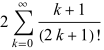
 has the series representation
![e=[sum_(k=0)^infty((-1)^k)/(k!)]^(-1),](/images/equations/e/NumberedEquation7.svg) |
(7)
|
as well as
 |  | ![[sum_(k=0)^(infty)(1-2k)/((2k)!)]^(-1)](/images/equations/e/Inline37.svg) |
(8)
|
 |  |  |
(9)
|
 |  |  |
(10)
|
 |  |  |
(11)
|
 |  |  |
(12)
|
 |  |  |
(13)
|
 |  | ![[sum_(k=0)^(infty)(4k+3)/(2^(2k+1)(2k+1)!)]^2.](/images/equations/e/Inline55.svg) |
(14)
|
The special case of the Euler formula
 |
(15)
|
with  gives the beautiful identity
 |
(16)
|
an equation connecting the fundamental numbers i, pi,  ,
1, and 0 (zero) and involving the fundamental operations
of equality (
,
1, and 0 (zero) and involving the fundamental operations
of equality ( ), addition
(
), addition
( ), multiplication
(
), multiplication
( ), and exponentiation.
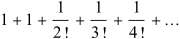
A nested series for  can be obtained by rewriting the series (2) for
  as
as
 |  |  |
(17)
|
 |  |  |
(18)
|
 |  |  |
(19)
|
which gives a pretty nested radical result when  is taken to the power of both sides.
An unexpected Wallis-like formula for  is given by the Pippenger
product
is given by the Pippenger
product
 |
(20)
|
(OEIS A084148 and A084149; Pippenger 1980). Another product for  given by
 |
(21)
|
due to Guillera (Sondow 2006). This is analogous to the products
 |
(22)
|
and
 |
(23)
|
(Guillera and Sondow 2005, Sondow 2006).
Using the recurrence relation
 |
(24)
|
with  , compute
 |
(25)
|
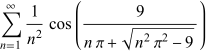
The result is  . Gosper gives the unusual equation
connecting
. Gosper gives the unusual equation
connecting  and
and  ,
,
 |  |  |
(26)
|
 |  |  |
(27)
|
(OEIS A100074).
Rabinowitz and Wagon (1995) give an algorithm for computing digits of  based on earlier digits
(Borwein and Bailey 2003, p. 140), but a much simpler spigot
algorithm was found by Sales in 1968. Around 1966, MIT hacker Eric Jensen wrote
a very concise program (requiring less than a page of assembly language) that computed
based on earlier digits
(Borwein and Bailey 2003, p. 140), but a much simpler spigot
algorithm was found by Sales in 1968. Around 1966, MIT hacker Eric Jensen wrote
a very concise program (requiring less than a page of assembly language) that computed
 by converting from factorial base to
decimal.
by converting from factorial base to
decimal.
Let  be the probability that a random
one-to-one function on the integers
1, ...,
be the probability that a random
one-to-one function on the integers
1, ...,  has at least one fixed
point. Then
has at least one fixed
point. Then
 |  |  |
(28)
|
 |  |  |
(29)
|
 |  |  |
(30)
|
(OEIS A068996).
Stirling's approximation gives
 |  |  |
(31)
|
 |  |  |
(32)
|
(OEIS A068985).
Steiner's problem asks for the largest value of the function  ,
which is given by
,
which is given by  .
.
Examples of  mnemonics
(Gardner 1959, 1991) include:
mnemonics
(Gardner 1959, 1991) include:
"By omnibus I traveled to Brooklyn" (6 digits).
"To disrupt a playroom is commonly a practice of children" (10 digits).
"It enables a numskull to memorize a quantity of numerals" (10 digits).
"I'm forming a mnemonic to remember a function in analysis" (10 digits).
"He repeats: I shouldn't be tippling, I shouldn't be toppling here!" (11 digits).
"In showing a painting to probably a critical or venomous lady, anger dominates. O take guard, or she raves and shouts" (21 digits). Here, the word "O" stands for the number 0.
A much more extensive mnemonic giving 40 digits is
"We present a mnemonic to memorize a constant so exciting that Euler exclaimed: '!' when first it was found, yes, loudly '!'. My students perhaps will compute  , use power or Taylor series, an easy
summation formula, obvious, clear, elegant!"
, use power or Taylor series, an easy
summation formula, obvious, clear, elegant!"
(Barel 1995). In the latter, 0s are represented with "!". A list of  mnemonics in several languages is maintained
by A. P. Hatzipolakis.
mnemonics in several languages is maintained
by A. P. Hatzipolakis.

 ,
e, and Euler's Constant." Math. Comput. 50, 275-281, 1988.Barel,
Z. "A Mnemonic for e." Math. Mag. 68, 253, 1995.Baruvelle,
H. V. "The Number e: The Base of Natural Logarithms." Math.
Teacher 38, 350-355, 1945.Borwein, J. and Bailey, D.
,
e, and Euler's Constant." Math. Comput. 50, 275-281, 1988.Barel,
Z. "A Mnemonic for e." Math. Mag. 68, 253, 1995.Baruvelle,
H. V. "The Number e: The Base of Natural Logarithms." Math.
Teacher 38, 350-355, 1945.Borwein, J. and Bailey, D.  ."
College Math. J. 35, 34-39, 2004.Brothers, H. J.
and Knox, J. A. "New Closed-Form Approximations to the Logarithmic Constant
e." Math. Intell. 20, 25-29, 1998.Caldwell,
C. K. and Dubner, H. "Primes in Pi." J. Recr. Math. 29,
282-289, 1998.Castellanos, D. "The Ubiquitous Pi. Part I."
Math. Mag. 61, 67-98, 1988.Conway, J. H. and Guy,
R. K.
."
College Math. J. 35, 34-39, 2004.Brothers, H. J.
and Knox, J. A. "New Closed-Form Approximations to the Logarithmic Constant
e." Math. Intell. 20, 25-29, 1998.Caldwell,
C. K. and Dubner, H. "Primes in Pi." J. Recr. Math. 29,
282-289, 1998.Castellanos, D. "The Ubiquitous Pi. Part I."
Math. Mag. 61, 67-98, 1988.Conway, J. H. and Guy,
R. K.  ."
§13 in
."
§13 in  ." Amer. Math. Monthly 87,
391, 1980.Plouffe, S. "Table of Current Records for the Computation
of Constants."
." Amer. Math. Monthly 87,
391, 1980.Plouffe, S. "Table of Current Records for the Computation
of Constants."  ." Amer. Math. Monthly 102, 195-203, 1995.Reid,
C. In
." Amer. Math. Monthly 102, 195-203, 1995.Reid,
C. In  Is Irrational?" Feb. 2006.
  Is Irrational and a New Measure of Its Irrationality." Amer. Math. Monthly 113,
637-641, 2006.Stoneham, R. "A General Arithmetic Construction of
Transcendental Non-Liouville Normal Numbers from Rational Functions." Acta
Arith. 16, 239-253, 1970.Wall, H. S.
Is Irrational and a New Measure of Its Irrationality." Amer. Math. Monthly 113,
637-641, 2006.Stoneham, R. "A General Arithmetic Construction of
Transcendental Non-Liouville Normal Numbers from Rational Functions." Acta
Arith. 16, 239-253, 1970.Wall, H. S.