



The simple continued fraction for pi is given by [3; 7, 15, 1, 292, 1, 1, 1, 2, 1, 3, 1, 14, 2, 1, 1, 2, 2, 2, 2, ...] (OEIS A001203). A plot of the first 256 terms of the continued fraction represented as a sequence of binary bits is shown above.
The first few convergents are 3, 22/7, 333/106, 355/113, 103993/33102, 104348/33215, ... (OEIS A002485 and A002486), which are good to 0, 2, 4, 6, 9, 9, 9, 10, 11, 11, 12, 13, ... (OEIS A114526) decimal digits, respectively.
The very large term 292 means that the convergent
![[3;7,15,1]=[3,7,16]=(355)/(113)=3.14159292...](/images/equations/PiContinuedFraction/NumberedEquation1.svg) |
(1)
|
is an extremely good approximation good to six decimal places that was first discovered by astronomer Tsu Ch'ung-Chih in the fifth century A.D. (Gardner 1966, pp. 91-102).
A nice expression for the third convergent of  is given by
![pi approx 2[1;1,1,3,32]=(355)/(113) approx 3.14159292...](/images/equations/PiContinuedFraction/NumberedEquation2.svg) |
(2)
|
(Stoschek).
The Engel expansion of  is 1, 1, 1, 8, 8, 17, 19, 300, 1991, 2492, ... (OEIS A006784).
The following table summarizes some record computations of the continued fraction of pi.
| terms | date | reference |
 | 1977 | W. Gosper (Gosper 1977, Ball and Coxeter 1987) |
 | Jun. 1999 | H. Havermann (Plouffe) |
 | Mar. 2002 | H. Havermann (Bickford) |
 | Oct. 2010 | N. Bickford (Bickford 2010, Wolfram Blog Team 2011) |
 | Dec. 2010 | E. W. Weisstein |
 | Sep. 16, 2011 | E. W. Weisstein |
 | Sep. 17, 2011 | E. W. Weisstein |
 | Sep. 18, 2011 | E. W. Weisstein |
 | Jul. 18, 2013 | E. W. Weisstein |
 | Jul. 27, 2013 | E. W. Weisstein |
The positions of the first occurrence of  , 2, ... in the continued fraction are 3, 8, 0, 29, 39, 31,
1, 43, 129, 99, ... (OEIS A225802). The smallest
integers which does not occur in the first
, 2, ... in the continued fraction are 3, 8, 0, 29, 39, 31,
1, 43, 129, 99, ... (OEIS A225802). The smallest
integers which does not occur in the first  terms are 49004, 50471, 53486, 56315, ... (E. Weisstein,
Jul. 27, 2013). The sequence of increasing terms in the continued
fraction is 3, 7, 15, 292, 436, 20776, 78629, 179136, 528210, 12996958, 878783625,
5408240597, 5916686112, 9448623833, ... (OEIS A033089),
occurring at positions 1, 2, 3, 5, 308, 432, 28422, 156382, 267314, 453294, 11504931
... (OEIS A033090).
terms are 49004, 50471, 53486, 56315, ... (E. Weisstein,
Jul. 27, 2013). The sequence of increasing terms in the continued
fraction is 3, 7, 15, 292, 436, 20776, 78629, 179136, 528210, 12996958, 878783625,
5408240597, 5916686112, 9448623833, ... (OEIS A033089),
occurring at positions 1, 2, 3, 5, 308, 432, 28422, 156382, 267314, 453294, 11504931
... (OEIS A033090).
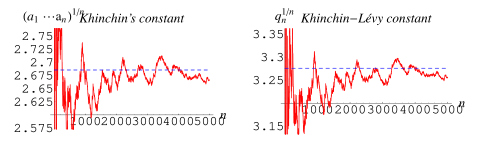
Let the continued fraction of  be denoted
 ![[a_0;a_1,a_2,...]](/images/equations/PiContinuedFraction/Inline16.svg) and let the denominators of the convergents
be denoted
and let the denominators of the convergents
be denoted  ,
,
 ,
...,
,
...,  .
Then plots above show successive values of
.
Then plots above show successive values of  ,
,  ,
, 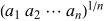 , which appear to converge to Khinchin's
constant (left figure) and
, which appear to converge to Khinchin's
constant (left figure) and  , which appear converge to the Lévy
constant (right figure), although neither of these limits has been rigorously
established.
, which appear converge to the Lévy
constant (right figure), although neither of these limits has been rigorously
established.
The following table gives the first few occurrences of  -digit terms in the continued
fraction of
-digit terms in the continued
fraction of  ,
counting 3 as the 0th (e.g., Choong et al. 1971, Beeler et al. 1972).
,
counting 3 as the 0th (e.g., Choong et al. 1971, Beeler et al. 1972).
 | OEIS | terms/positions |
| 1 | A048292 | 3, 7, 1, 1, 1, 1, 2, 1, 3, 1, 2, 1, 1, 2, ... |
| A048293 | 0, 1, 3, 5, 6, 7, 8, 9, 10, 11, 13, 14, ... | |
| 2 | A048294 | 15, 14, 84, 15, 13, 99, 12, 16, 45, 22, ... |
| A048955 | 2, 12, 21, 25, 27, 33, 54, 77, 80, 82, ... | |
| 3 | A048956 | 292, 161, 120, 127, 436, 106, 141, ... |
| A048957 | 4, 79, 196, 222, 307, 601, 669, 725, ... | |
| 4 | A048958 | 1722, 2159, 8277, 1431, 1282, 2050, ... |
| A048959 | 3273, 3777, 3811, 4019, 4700, 6209, ... | |
| 5 | A048960 | 20776, 19055, 19308, 78629, 17538, ... |
| A048961 | 431, 15543, 23398, 28421, 51839, ... | |
| 6 | 179136, 528210, 104293, 196030, ... | |
| 156381, 267313, 294467, 513205, ... | ||
| 7 | 8093211, 1811791, 3578547, 4506503, ... | |
| 1118727, 2782369, 2899883, 3014261, ... | ||
| 8 | 12996958 ,19626118, 12051Q034, 13435395, ... | |
| 453293, 27741604, 46924606, 50964645, ... | ||
| 9 | 878783625, 317579569, ... | |
| 11504930, 74130513, ... |
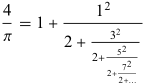
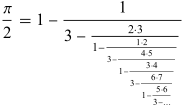
The simple continued fraction for  does not show any obvious patterns,
but clear patterns do emerge in the beautiful non-simple continued
fractions
does not show any obvious patterns,
but clear patterns do emerge in the beautiful non-simple continued
fractions
 |
(3)
|
(Brouncker), giving convergents 1, 3/2, 15/13, 105/76, 315/263, ... (OEIS A025547 and A007509) and
 |
(4)
|
(Stern 1833), giving convergents 1, 2/3, 4/3, 16/15, 64/45, 128/105, ... (OEIS A001901 and A046126).

 and the Derived Decimal Approximation. Stanford, CA:
Artificial Intelligence Laboratory, Stanford University, Oct. 1975. Reviewed
in Math. Comput. 31, 1044, 1977.Havermann, H. "Simple
Continued Fraction Expansion of Pi."
and the Derived Decimal Approximation. Stanford, CA:
Artificial Intelligence Laboratory, Stanford University, Oct. 1975. Reviewed
in Math. Comput. 31, 1044, 1977.Havermann, H. "Simple
Continued Fraction Expansion of Pi."  ." Monatsh. für Math. 67, 311-316,
1963.Sloane, N. J. A. Sequences
." Monatsh. für Math. 67, 311-316,
1963.Sloane, N. J. A. Sequences