

A Liouville number is a transcendental number which has very close rational number approximations.
An irrational number  is called a Liouville number if, for each
  , there exist integers
  and
and  such that
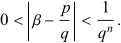 |
Note that the first inequality is true by definition, since it follows immediately from the fact that  is irrational and hence cannot be equal to
  for any values of
  and
and  .
.
Liouville's constant is an example of a Liouville number and is sometimes called "the" Liouville number or "Liouville's
number" (Wells 1986, p. 26). Mahler (1953) proved that  is not a Liouville number.

 ." Nederl. Akad. Wetensch. Proc. Ser. A. 56/Indagationes
Math. 15, 30-42, 1953.Wells, D.
." Nederl. Akad. Wetensch. Proc. Ser. A. 56/Indagationes
Math. 15, 30-42, 1953.Wells, D.