


Convergents of the pi continued fractions are the simplest approximants to  . The first few are given by 3, 22/7, 333/106, 355/113, 103993/33102,
104348/33215, ... (OEIS A002485 and A002486),
which are good to 0, 2, 4, 6, 9, 9, 9, 10, 11, 11, 12, 13, ... (OEIS A114526)
decimal digits, respectively.
. The first few are given by 3, 22/7, 333/106, 355/113, 103993/33102,
104348/33215, ... (OEIS A002485 and A002486),
which are good to 0, 2, 4, 6, 9, 9, 9, 10, 11, 11, 12, 13, ... (OEIS A114526)
decimal digits, respectively.
Two approximations follow from the near-identity function  evaluated at
  and
and  ,
giving
,
giving
 |  |  |
(1)
|
 |  |  |
(2)
|
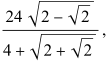
which are good to 2 and 3 digits, respectively. Kochanski's approximation is the root of
 |
(3)
|
given by
 |
(4)
|
which is good to 4 digits.
Another curious fact is the almost integer
 |
(5)
|
which can also be written as
 |
(6)
|
 |
(7)
|
Here,  is Gelfond's constant. Applying cosine
a few more times gives
is Gelfond's constant. Applying cosine
a few more times gives
 |
(8)
|
Another approximation involving  is given by
 |
(9)
|
which is good to 2 decimal digits (A. Povolotsky, pers. comm., Mar. 6, 2008).
An apparently interesting near-identity is given by
 |
(10)
|
which becomes less surprising when it is noted that 555555 is a repdigit, so the above is just a special case of the near-identity
 |  |  |
(11)
|
 |  |  |
(12)
|
with  and
and  .
.
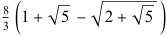
An approximation involving the golden ratio  arises from the volume
of the canonical tetragonal
antiwedge with unit midradius, namely
arises from the volume
of the canonical tetragonal
antiwedge with unit midradius, namely
 |  |  |
(13)
|
 |  |  |
(14)
|
 |  |  |
(15)
|
(cf. Pegg 2018), which is good to 3 digits. Anopther approximation involving  is
is
 |  |  |
(16)
|
 |  |  |
(17)
|
 |  |  |
(18)
|
 |  |  |
(19)
|
which is good to 4 digits. A similar approximation due to S. Mircea-Mugurel (pers. comm., Oct. 30, 2002) is given by
 |
(20)
|
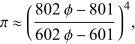
which however is only good to two decimal places. Another approximation involving the golden ratio  is given by
 |
(21)
|
which is good to 7 digits (K. Rashid, pers. comm.).
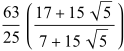
Some approximations due to Ramanujan include
 |  |  |
(22)
|
 |  |  |
(23)
|
 |  |  |
(24)
|
 |  |  |
(25)
|
 |  |  |
(26)
|
 |  |  |
(27)
|
 |  | ![(12)/(sqrt(130))ln[((3+sqrt(13))(sqrt(8)+sqrt(10)))/2]](/images/equations/PiApproximations/Inline65.svg) |
(28)
|
 |  | ![(24)/(sqrt(142))ln[(sqrt(10+11sqrt(2))+sqrt(10+7sqrt(2)))/2]](/images/equations/PiApproximations/Inline68.svg) |
(29)
|
 |  | ![(12)/(sqrt(190))ln[(3+sqrt(10))(sqrt(8)+sqrt(10))]](/images/equations/PiApproximations/Inline71.svg) |
(30)
|
 |  | ![(12)/(sqrt(310))ln[1/4(3+sqrt(5))(2+sqrt(2))(5+2sqrt(10)+sqrt(61+20sqrt(10)))]](/images/equations/PiApproximations/Inline74.svg) |
(31)
|
 |  | ![4/(sqrt(522))ln[((5+sqrt(29))/(sqrt(2)))^3(5sqrt(29)+11sqrt(6))(sqrt((9+3sqrt(6))/4)+sqrt((5+3sqrt(6))/4))^6],](/images/equations/PiApproximations/Inline77.svg) |
(32)
|
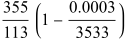
which are accurate to 3, 4, 4, 8, 8, 9, 14, 15, 15, 18, 23, 31 digits, respectively (Ramanujan 1913-1914; Hardy 1952, p. 70; Wells 1986, p. 54; Berndt 1994, pp. 48-49 and 88-89). Equation (◇) and the similar
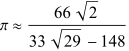 |
(33)
|
are also given by Borwein and Bailey (2003, p. 135). Ramanujan also gave
 |
(34)
|
(Wells 1986, p. 54).
It is not hard to find rational approximations to  using two pandigital numbers
(A. Povolotsky, pers. comm., Aug.29, 2022). The best such approximation is
using two pandigital numbers
(A. Povolotsky, pers. comm., Aug.29, 2022). The best such approximation is
 |
(35)
|
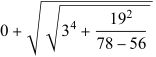
which approximates  to 10 decimal digits (E. Weisstein, Sep. 7, 2022). S. Irvine (pers.
comm.) noted that (◇), giving an approximation to
to 10 decimal digits (E. Weisstein, Sep. 7, 2022). S. Irvine (pers.
comm.) noted that (◇), giving an approximation to  good to 8 digits, can be written in a pandigital
form as
good to 8 digits, can be written in a pandigital
form as
 |  |  |
(36)
|
 |  |  |
(37)
|
 |  |  |
(38)
|
(S. Plouffe, pers. comm.; cf. Wells 1986, p. 54). E. Pegg (pers. comm.) found the pandigital approximation
 |
(39)
|
which approximates  to 9 digits. Another pandigital formula is given
by
to 9 digits. Another pandigital formula is given
by
 |
(40)
|
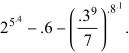
(B. Astle, pers. comm., Jan. 9, 2004), which approximates  to 9 digits. Surpassing both of these is the pandigital
approximation
to 9 digits. Surpassing both of these is the pandigital
approximation
 |
(41)
|
which gives 10 correct digits (B. Ziv, pers. comm., Jul. 7, 2004). A further pandigital approximation is given by
![(ln{[2×5!+(8-1)!]^(sqrt(9))+4!+(3!)!})/(sqrt(67)),](/images/equations/PiApproximations/NumberedEquation17.svg) |
(42)
|
which is good to 17 digits (G. W. Barbosa, pers. comm.).
M. Schneider (pers. comm., May 6, 2008) found the approximation
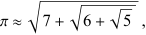 |
(43)
|
which is good to 3 decimal digits. P. Lindborg (pers. comm.) noted that the convergent 104348/33125 can be written in the slightly curious form
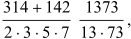 |
(44)
|
which is good to 9 digits.
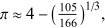
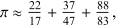
Other approximations due to E. Pegg include
 |
(45)
|
which is good to 6 digits (pers. comm., March 2, 2002) and
 |
(46)
|
which is good to 9 digits (pers. comm., Dec. 30, 2002).
A simple approximation involving the cube root is
 |
(47)
|
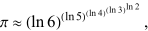
which is good to 3 digits (M. Joseph, pers. comm., May 3, 2006). A more exotic one is given by
 |
(48)
|
which is good to 4 digits (M. Joseph, pers. comm., May 3, 2006).
Castellanos (1988ab) gives a slew of curious formulas:
 |  |  |
(49)
|
 |  |  |
(50)
|
 |  |  |
(51)
|
 |  |  |
(52)
|
 |  |  |
(53)
|
 |  |  |
(54)
|
 |  |  |
(55)
|
 |  |  |
(56)
|
 |  |  |
(57)
|
 |  |  |
(58)
|
 |  |  |
(59)
|
 |  |  |
(60)
|
 |  |  |
(61)
|
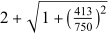
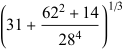
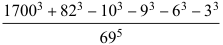
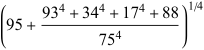
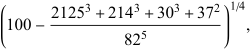
which are accurate to 3, 4, 4, 5, 6, 7, 7, 8, 9, 10, 11, 12, and 13 digits, respectively. An extremely accurate approximation due to Shanks (1982) is
 |
(62)
|
where  is the product of four simple quartic units.
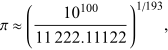
David W. Hoffman (pers. comm.) gave
 |
(63)
|
where the numerator is one googol, which is good to 9 digits. The approximations
 |  |  |
(64)
|
 |  |  |
(65)
|
give 2 digits (G. von Hippel, pers. comm.).
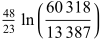
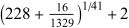
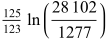
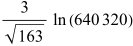
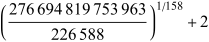
A sequence of approximations due to Plouffe and Borwein and Bailey (2003, pp. 115 and 134-135) includes
 |  |  |
(66)
|
 |  |  |
(67)
|
 |  |  |
(68)
|
 |  |  |
(69)
|
 |  |  |
(70)
|
 |  |  |
(71)
|
 |  |  |
(72)
|
 |  |  |
(73)
|
 |  |  |
(74)
|
 |  |  |
(75)
|
 |  |  |
(76)
|
 |  |  |
(77)
|
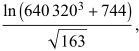
which are accurate to 4, 5, 7, 7, 9, 10, 11, 11, 11, 15, 23, and 30 digits, respectively.
The last expression, which follows from the series expansion of the j-function. Carrying this one step further gives
 |
(78)
|
 |
(79)
|
 |
(80)
|
 |
(81)
|
giving
![pi approx (ln[(640320^3+744)^2-2·196884])/(2sqrt(163)),](/images/equations/PiApproximations/NumberedEquation30.svg) |
(82)
|
which is good to 46 decimal digits (Warda, pers. comm., Nov. 15, 2004).
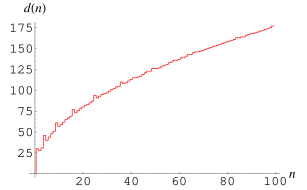
Interestingly,  gives successively good approximations to
  for larger and larger
  (Warda, pers. comm., Nov. 22, 2004). In particular, the
number of correct digits for
(Warda, pers. comm., Nov. 22, 2004). In particular, the
number of correct digits for  , 2, ... are given by 30, 28, 31, 46, 40, 44, 48, 51, 61,
57, 59, 62, 65 (OEIS A100935).
, 2, ... are given by 30, 28, 31, 46, 40, 44, 48, 51, 61,
57, 59, 62, 65 (OEIS A100935).
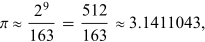
An approximation due to Stoschek using powers of two and the special number 163 (the largest Heegner number) is given by
 |
(83)
|
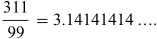
which is good to 3 digits. A fraction with small numerator and denominator which gives a close approximation to  is
is
 |
(84)
|
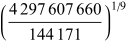
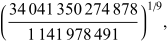
Some approximations involving the ninth roots of rational numbers include
 |  |  |
(85)
|
 |  |  |
(86)
|
which are good to 12 and 15 digits, respectively (P. Galliani, pers. comm.).
de Jerphanion (pers. comm.) found
 |
(87)
|
which is good to 9 digits, and J. Iuliano found
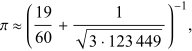 |
(88)
|
which is good to 11 digits.
Definite integrals giving approximations to  were considered by Backhouse (1995) and Lucas (2005).
F. Voormanns (pers. comm., Dec. 12, 2003) found the curious astronomical approximation
 |
(89)
|
which is accurate to 8 digits if the year is taken as exactly 365 days, or 6 digits if the average Gregorian year (365.2425 days) or tropical year (365.242190 days) is used.
Rivera gives other approximation formulas.

 ."
Math. Gaz. 79, 371-374, 1995.Berndt, B. C.
."
Math. Gaz. 79, 371-374, 1995.Berndt, B. C.  ." Gaz. Austral. Math. Soc. 32,
263-266, 2005.Pegg, E. Jr. "For Pi Day: Volume = 3.141--The
Canonical Tetragonal Antiwedge Hexahedron." Mar. 14, 2018.
." Gaz. Austral. Math. Soc. 32,
263-266, 2005.Pegg, E. Jr. "For Pi Day: Volume = 3.141--The
Canonical Tetragonal Antiwedge Hexahedron." Mar. 14, 2018.  ." Quart. J. Pure. Appl. Math. 45, 350-372,
1913-1914.Rivera, C. "Problems & Puzzles: Puzzle 050-The Best
Approximation to Pi with Primes."
." Quart. J. Pure. Appl. Math. 45, 350-372,
1913-1914.Rivera, C. "Problems & Puzzles: Puzzle 050-The Best
Approximation to Pi with Primes."  ." J. Number. Th. 14, 397-423, 1982.Sloane,
N. J. A. Sequences
." J. Number. Th. 14, 397-423, 1982.Sloane,
N. J. A. Sequences