


A normal distribution in a variate  with mean
  and variance
  is a statistical
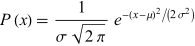
distribution with probability density
function
is a statistical
distribution with probability density
function
 |
(1)
|
on the domain  . While statisticians and mathematicians
uniformly use the term "normal distribution" for this distribution, physicists
sometimes call it a Gaussian distribution and, because of its curved flaring shape,
social scientists refer to it as the "bell curve." Feller (1968) uses the
symbol
. While statisticians and mathematicians
uniformly use the term "normal distribution" for this distribution, physicists
sometimes call it a Gaussian distribution and, because of its curved flaring shape,
social scientists refer to it as the "bell curve." Feller (1968) uses the
symbol  for
for  in the above equation, but then switches to
  in Feller (1971).
de Moivre developed the normal distribution as an approximation to the binomial distribution, and it was subsequently used by Laplace in 1783 to study measurement errors and by Gauss in 1809 in the analysis of astronomical data (Havil 2003, p. 157).
The normal distribution is implemented in the Wolfram Language as NormalDistribution[mu, sigma].
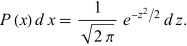
The so-called "standard normal distribution" is given by taking  and
and  in a general normal distribution. An arbitrary normal distribution can be converted
to a standard normal distribution
by changing variables to
in a general normal distribution. An arbitrary normal distribution can be converted
to a standard normal distribution
by changing variables to  , so
, so  , yielding
 |
(2)
|
The Fisher-Behrens problem is the determination of a test for the equality of means for two normal distributions with different variances.
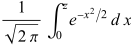
The normal distribution function  is used here in the centered convention,
 |  |  |
(3)
|
 |  |  |
(4)
|
where erf is a function sometimes called the error function. For  ,
,  is the probability that
a variate from the standard
normal distribution lies in
is the probability that
a variate from the standard
normal distribution lies in ![[0,z]](/images/equations/NormalDistribution/Inline21.svg) . For
. For  , the integral is negative
and the probability of
, the integral is negative
and the probability of ![[z,0]](/images/equations/NormalDistribution/Inline23.svg) is
is  . The cumulative distribution
function of the standard normal distribution
is
. The cumulative distribution
function of the standard normal distribution
is  ,
a quantity also commonly denoted by
,
a quantity also commonly denoted by  . Neither
  nor erf can be expressed in terms
of finite additions, subtractions, multiplications, and
root extractions, and so both must be either computed
numerically or otherwise approximated.
nor erf can be expressed in terms
of finite additions, subtractions, multiplications, and
root extractions, and so both must be either computed
numerically or otherwise approximated.

The normal distribution is the limiting case of a discrete binomial distribution  as the sample size
  becomes large, in which case
  is normal with mean and variance
 |  |  |
(5)
|
 |  |  |
(6)
|
with  .
.
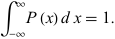
The distribution 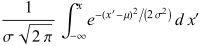 is properly normalized since
 |
(7)
|
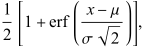
The cumulative distribution function, which gives the probability that a variate
will assume a value  , is then the integral of
the normal distribution,
, is then the integral of
the normal distribution,
 |  |  |
(8)
|
 |  |  |
(9)
|
 |  | ![1/2[1+erf((x-mu)/(sigmasqrt(2)))],](/images/equations/NormalDistribution/Inline48.svg) |
(10)
|
where erf is the so-called error function.
Normal distributions have many convenient properties, so random variates with unknown distributions are often assumed to be normal, especially in physics and astronomy. Although this can be a dangerous assumption, it is often a good approximation due to a surprising result known as the central limit theorem. This theorem states that the mean of any set of variates with any distribution having a finite mean and variance tends to the normal distribution. Many common attributes such as test scores, height, etc., follow roughly normal distributions, with few members at the high and low ends and many in the middle.
Because they occur so frequently, there is an unfortunate tendency to invoke normal distributions in situations where they may not be applicable. As Lippmann stated, "Everybody believes in the exponential law of errors: the experimenters, because they think it can be proved by mathematics; and the mathematicians, because they believe it has been established by observation" (Whittaker and Robinson 1967, p. 179).
Among the amazing properties of the normal distribution are that the normal sum distribution and normal difference
distribution obtained by respectively adding and subtracting variates  and
and 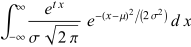 from two independent normal distributions with arbitrary means and variances are also normal!
The normal ratio distribution obtained
from
from two independent normal distributions with arbitrary means and variances are also normal!
The normal ratio distribution obtained
from  has a Cauchy distribution.
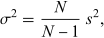
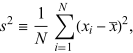
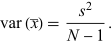
Using the k-statistic formalism, the unbiased estimator for the variance of a normal distribution is given by
 |
(11)
|
where
 |
(12)
|
so
 |
(13)
|
The characteristic function for the normal distribution is
 |
(14)
|
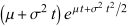
and the moment-generating function is
 |  |  |
(15)
|
 |  |  |
(16)
|
 |  |  |
(17)
|
so
 |  |  |
(18)
|
 |  |  |
(19)
|
and
 |  |  |
(20)
|
 |  | ![M^('')(0)-[M^'(0)]^2=sigma^2.](/images/equations/NormalDistribution/Inline72.svg) |
(21)
|
These can also be computed using
 |  | ![ln[M(t)]=mut+1/2sigma^2t^2](/images/equations/NormalDistribution/Inline75.svg) |
(22)
|
 |  |  |
(23)
|
 |  |  |
(24)
|
yielding, as before,
 |  |  |
(25)
|
 |  |  |
(26)
|
The raw moments can also be computed directly by computing the raw moments  ,
,
 |
(27)
|
(Papoulis 1984, pp. 147-148). Now let
 |  |  |
(28)
|
 |  |  |
(29)
|
 |  |  |
(30)
|
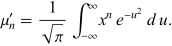
giving the raw moments in terms of Gaussian integrals,
 |
(31)
|
Evaluating these integrals gives
 |  |  |
(32)
|
 |  |  |
(33)
|
 |  |  |
(34)
|
 |  |  |
(35)
|
 |  |  |
(36)
|
Now find the central moments,
 |  |  |
(37)
|
 |  |  |
(38)
|
 |  |  |
(39)
|
 |  |  |
(40)
|
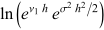
The variance, skewness, and kurtosis excess are given by
 |  |  |
(41)
|
 |  |  |
(42)
|
 |  |  |
(43)
|
The cumulant-generating function for a normal distribution is
 |  |  |
(44)
|
 |  |  |
(45)
|
so
 |  |  |
(46)
|
 |  |  |
(47)
|
 |  |  |
(48)
|
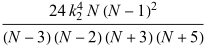
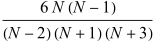
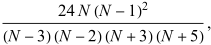
For normal variates,  for
for 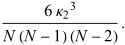 , so the variance of k-statistic
  is
is
 |  |  |
(49)
|
 |  |  |
(50)
|
Also,
 |  |  |
(51)
|
 |  |  |
(52)
|
 |  |  |
(53)
|
where
 |  |  |
(54)
|
 |  |  |
(55)
|
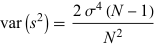
The variance of the sample variance  for a general distribution is given by
![var(s^2)=((N-1)[(N-1)mu_4-(N-3)mu_2^2])/(N^3),](/images/equations/NormalDistribution/NumberedEquation10.svg) |
(56)
|
which simplifies in the case of a normal distribution to
 |
(57)
|
(Kenney and Keeping 1951, p. 164).
If  is a normal distribution, then
![D(x)=1/2[1+erf((x-mu)/(sigmasqrt(2)))],](/images/equations/NormalDistribution/NumberedEquation12.svg) |
(58)
|
so variates  with a normal distribution can be generated from variates
  having a uniform
distribution in (0,1) via
having a uniform
distribution in (0,1) via
 |
(59)
|
However, a simpler way to obtain numbers with a normal distribution is to use the Box-Muller transformation.
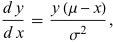
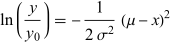
The differential equation having a normal distribution as its solution is
 |
(60)
|
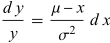
since
 |
(61)
|
 |
(62)
|
 |
(63)
|
This equation has been generalized to yield more complicated distributions which are named using the so-called Pearson system.
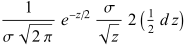
The normal distribution is also a special case of the chi-squared distribution, since making the substitution
 |
(64)
|
gives
 |  |  |
(65)
|
 |  |  |
(66)
|
Now, the real line  is mapped onto the half-infinite interval
  by this transformation, so an extra factor of
2 must be added to
by this transformation, so an extra factor of
2 must be added to  , transforming
  into
into
 |  |  |
(67)
|
 |  |  |
(68)
|
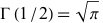
(Kenney and Keeping 1951, p. 98), where use has been made of the identity  . As promised, (68) is a chi-squared distribution
in
. As promised, (68) is a chi-squared distribution
in  with
with  (and also a gamma distribution with
  and
and  ).
).
