


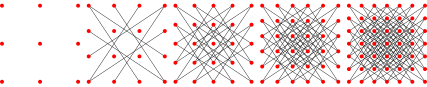
A zebra graph is a graph formed by all possible moves of a hypothetical chess piece called a "zebra" which
moves analogously to a knight except that it is restricted to moves that change by
two squares along one axis of
the board and three squares along the other. To form the
graph, each chessboard square is considered a vertex,
and vertices connected by allowable zebra moves are
joined by edges. The graphs
above give the positions on square chessboards that
are reachable by zebra moves. Zebra graphs are therefore  -leaper graphs, as well
as Euclidean distance graphs with distance
-leaper graphs, as well
as Euclidean distance graphs with distance
 .
.
Zebra graphs are bicolorable, bipartite, class 1, perfect, triangle-free, and weakly perfect.
The square ( )
zebra graph is connected for
)
zebra graph is connected for  and
and  .
.
For  square boards, the zebra graph
is traceable exactly when
square boards, the zebra graph
is traceable exactly when  ,
,  ,
or
,
or  . This can be proved as follows.
For board sides 14 through 23, construct Hamiltonian
paths with two chosen corner edges. Add strips
of width 10 on the right and along the bottom, and join the strips' Hamiltonian
cycles to the original Hamiltonian path.
This gives a Hamiltonian path on a board of side
. This can be proved as follows.
For board sides 14 through 23, construct Hamiltonian
paths with two chosen corner edges. Add strips
of width 10 on the right and along the bottom, and join the strips' Hamiltonian
cycles to the original Hamiltonian path.
This gives a Hamiltonian path on a board of side
 with the corner edges
needed to repeat the construction (E. Weisstein, Oct. 5, 2026).
with the corner edges
needed to repeat the construction (E. Weisstein, Oct. 5, 2026).
The smallest nontrivial square board where a Hamiltonian cycle exists (i.e., for which the underlying zebra graph is Hamiltonian)
is the  board, first solved by Frost (1886, cited by Jelliss 2019). There are a total of
 Hamiltonian
cycles on this board. For
Hamiltonian
cycles on this board. For  , the square board is Hamiltonian
for exactly
, the square board is Hamiltonian
for exactly  ,
10, 14, 16, 18, and 20. The square zebra graph is also Hamiltonian
for all sufficiently large even
,
10, 14, 16, 18, and 20. The square zebra graph is also Hamiltonian
for all sufficiently large even  (Beluhov 2022).
Precomputed properties of zebra graphs are implemented in the Wolfram Language as GraphData[ "Zebra",
  m, n
m, n
 ].
].

 2, 3
2, 3 ."
§10.31 in Knight's Tour Notes. 2019.
."
§10.31 in Knight's Tour Notes. 2019.