


A triangle-free graph is a graph containing no graph cycles of length three. A simple graph is triangle-free
iff  , where
 is the adjacency matrix
of the graph and
 is the matrix trace.
By Mantel's theorem, a triangle-free simple graph on  graph vertices has at most
 graph edges, with equality
exactly for the complete bipartite graph
 , where
 and
 denote the floor function
and ceiling function, respectively.
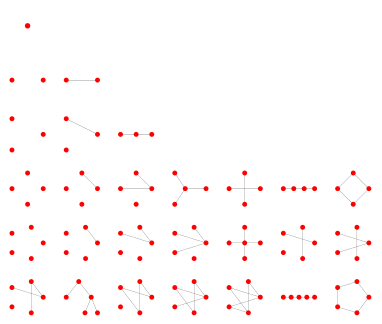
The numbers of triangle-free simple graphs, up to graph isomorphism, on  , 2, 3, ... nodes are 1,
2, 3, 7, 14, 38, 107, 410, 1897, ... (OEIS A006785),
the first few of which are illustrated above.
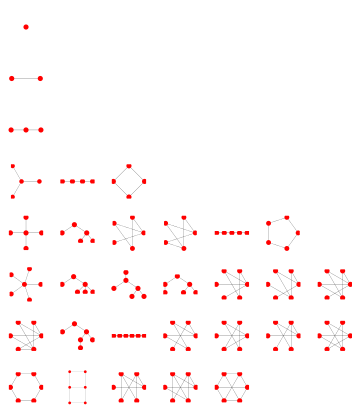
The numbers of triangle-free connected simple graphs, up to graph isomorphism, on  , 2, 3, ... nodes
are 1, 1, 1, 3, 6, 19, 59, 267, ... (OEIS A024607),
the first few of which are illustrated above.
For a triangle-free graph  on
 vertices, the least
eigenvalue of its signless
Laplacian matrix satisfies
 (Cai et al. 2026). The Higman-Sims graph and its balanced blow-ups attain
equality. Cai et al. (2026) report GPT-6.1 Sol assistance with the proof and
verification code.
Tuza's conjecture asks whether every simple graph can be made triangle-free by deleting at most twice its maximum number of pairwise edge-disjoint triangles. Kandasamy (2026) proved this for maximum vertex degree at most 10, with disclosed AI assistance in code and part of a proof lemma.
