A cylindrical algebraic decomposition of is a finite set partition
of
into cells, with a fixed ordering of the coordinates,
such that the coordinate projections of any two cells
onto the first coordinates are either identical
or disjoint for each (Basu 2017). The cells are connectedsemialgebraic sets built recursively as follows.
A cell in is an open interval or a
point. A cell in has one of the forms
(1)
or
(2)
where and is a cell in . The finite bounds are continuoussemialgebraic functions on . The lower bound of the first form may also be , and its upper bound may be , with throughout . The second form requires a finite-valued .
is a single cell described by the simultaneous inequalities
(4)
The figure above shows a decomposition of the unit circle into four cells, the two endpoint cells and together with the two arcs
(5)
The two arcs have the same projection onto the -axis, the open interval.
The endpoint cells project onto and . These lower-dimensional cells are needed to include the
entire boundary of the closed
disk. Reversing the coordinate order instead
separates the top and bottom endpoints (Trott 2006).
A three-dimensional example comes from integration over a regular octahedron of unit edge length, with
vertices and . The coordinate planes
split its interior into eight congruent full-dimensional
cells. The figure above shows their closures separated for visibility and one cell
with its projection onto the -plane. The positive-octant cell has bounds
(6)
Lower-dimensional cells complete the decomposition on the splitting planes and boundary. They have zero volume
and do not affect these volume integrals.
The determinant has negative sign on
and
and positive sign on . The absolute value in
the integrand can therefore be replaced by the appropriate
signed expression on each cell. The vertical split at makes the projections of
the cells onto the -axis identical or disjoint.
Lower-dimensional cell boundaries have zero area. The full
picking integral ranges over all six vertex coordinates.
The command CylindricalDecomposition[ineqs, x1,
x2, ...] performs cylindrical algebraic decompositions in the Wolfram
Language. Although the process is algorithmic, it can become computationally
expensive as the number of variables increases.
Arnborg, S. and Feng, H. "Algebraic Decomposition of Regular Curves." J. Symb. Comput.5, 131-140, 1988. https://doi.org/10.1016/S0747-7171(88)80009-9.Arnon,
D. S.; Collins, G. E.; and McCallum, S. "Cylindrical Algebraic Decomposition
I: The Basic Algorithm." SIAM J. Comput.13, 865-877, 1984. https://doi.org/10.1137/0213054.Arnon,
D. S. and Mignotte, M. "On Mechanical Quantifier Elimination for Elementary
Algebra and Geometry." J. Symb. Comput.5, 237-259, 1988. https://doi.org/10.1016/S0747-7171(88)80014-2.Basu,
S. "Algorithms in Real Algebraic Geometry: A Survey." In Real Algebraic
Geometry (Ed. K. Bekka, G. Fichou, J.-P. Monnier, and R. Quarez).
Paris, France: Soc. Math. France, pp. 107-153, 2017. https://smf.emath.fr/node/44883.
https://www.math.purdue.edu/~sbasu/raag_survey2011_final-sep4-2014.pdf.Basu,
S.; Pollack, R.; and Roy, M.-F. Algorithms
in Real Algebraic Geometry, 2nd ed. Berlin, Germany: Springer-Verlag, 2006.
https://doi.org/10.1007/3-540-33099-2.Brown,
C. W. "Simple CAD Construction and Its Applications." J. Symb.
Comput.31, 521-547, 2001. https://doi.org/10.1006/jsco.2000.0394.Buchberger,
B.; Collins, G. E.; and Kutzler, B. "Algebraic Methods for Geometric Reasoning."
Ann. Rev. Comput. Sci.3, 85-119, 1988. https://doi.org/10.1146/annurev.cs.03.060188.000505.Caviness,
B. F. and Johnson, J. R. (Ed.). Quantifier
Elimination and Cylindrical Algebraic Decomposition. Vienna, Austria: Springer-Verlag,
1998. https://doi.org/10.1007/978-3-7091-9459-1.Chen,
F. and Wang, D. (Ed.). Geometric
Computation. Singapore: World Scientific, 2004.Collins, G. E.
"Quantifier Elimination for Real Closed Fields by Cylindrical Algebraic Decomposition."
In Automata Theory and Formal Languages: 2nd GI Conference, Kaiserslautern, May
20-23, 1975 (Ed. H. Brakhage). Berlin, Germany: Springer-Verlag, pp. 134-183,
1975. https://doi.org/10.1007/3-540-07407-4_17.Collins,
G. E. "Quantifier Elimination by Cylindrical Algebraic Decomposition--Twenty
Years of Progress." In Quantifier
Elimination and Cylindrical Algebraic Decomposition (Ed. B. F. Caviness
and J. R. Johnson). New York: Springer-Verlag, pp. 8-23, 1998.Collins,
G. E. and Hong, H. "Partial Cylindrical Algebraic Decomposition for Quantifier
Elimination." J. Symb. Comput.12, 299-328, 1991.Dolzmann,
A. and Sturm, T. "Simplification of Quantifier-Free Formulae over Ordered Fields."
J. Symb. Comput.24, 209-231, 1997.Dolzmann, A.; Sturm,
T.; and Weispfenning, V. "Real Quantifier Elimination in Practice." In
Algorithmic Algebra and Number Theory (Ed. B. H. Matzat, G.-M. Greuel,
and G. Hiss). Berlin, Germany: Springer-Verlag, pp. 221-247, 1999. https://doi.org/10.1007/978-3-642-59932-3_11.Faugere,
J. C.; Gianni, P.; Lazard, D.; and Mora, T. "Efficient Computation of Zero-Dimensional
Groebner Bases by Change of Ordering." J. Symb. Comput.16, 329-344,
1993.Hong, H. "An Improvement of the Projection Operator in Cylindrical
Algebraic Decomposition." In ISSAC
'90: Proceedings of the International Symposium on Symbolic and Algebraic Computation,
August 20-24, 1990, Tokyo, Japan (Ed. S. Watanabe and M. Nagata).
New York: ACM Press, pp. 261-264, 1990.Loos, R. and Weispfenning,
V. "Applying Lattice Quantifier Elimination." Comput. J.36,
450-461, 1993.McCallum, S. "An Improved Projection for Cylindrical
Algebraic Decomposition of Three Dimensional Space." J. Symb. Comput.5,
141-161, 1988.McCallum, S. "Solving Polynomial Strict Inequalities
Using Cylindrical Algebraic Decomposition." Comput. J.36, 432-438,
1993. https://doi.org/10.1093/comjnl/36.5.432.McCallum,
S. "Recent Progress on Consistency Testing for Polynomial Systems." In
Computational Algebra and Number Theory (Ed. W. Bosma and A. van
der Poorten). Dordrecht, Netherlands: Kluwer Academic Publishers, pp. 243-253,
1995. https://doi.org/10.1007/978-94-017-1108-1_17.McCallum,
S. "An Improved Projection for Cylindrical Algebraic Decomposition." In
Quantifier
Elimination and Cylindrical Algebraic Decomposition (Ed. B. F. Caviness
and J. R. Johnson). New York: Springer-Verlag, pp. 242-268, 1998.McCallum,
S. and Collins, G. E. "Local Box Adjacency Algorithms for Cylindrical Algebraic
Decompositions." J. Symb. Comput.33, 321-342, 2002.Mishra,
B. "Computational Real Algebraic Geometry." In Handbook
of Discrete and Computational Geometry (Ed. J. E. Goodman and J. O'Rourke).
Boca Raton, FL: CRC Press, pp. 537-558, 1997.Rulf, F. "Bestimmung
der neuen Integrationsgrenzen für ein vielfaches Integral bei Vertauschung der
Integrationsfolge mittels der Aussagentheorie der Algebra der Logik." Monatsh.
Math. Phys.29, 268-276, 1918. https://doi.org/10.1007/BF01700490.Strzebonski,
A. "An Algorithm for Systems of Strong Polynomial Inequalities." Mathematica
J.4, 74-77, 1994.Strzebonski, A. "A Real Polynomial
Decision Algorithm Using Arbitrary-Precision Floating Point Arithmetic." Reliable
Comput.5, 337-346, 1999.Strzebonski, A. "Solving Algebraic
Inequalities." Mathematica J.7, 525-541, 2000.Trott,
M. "Polynomials in Inequalities." §1.2.3 in The
Mathematica GuideBook for Symbolics. New York: Springer-Verlag, pp. 50-78,
2006. https://www.mathematicaguidebooks.org/.Wolfram
Research. "GenericCylindricalDecomposition." 2007. https://reference.wolfram.com/language/ref/GenericCylindricalDecomposition.html.


 is a finite set partition
of
 into cells, with a fixed ordering of the coordinates,
such that the coordinate projections of any two cells
onto the first
 coordinates are either identical
or disjoint for each
 (Basu 2017). The cells are connected semialgebraic sets built recursively as follows.
 is an open interval or a
point. A cell in
 has one of the forms


 and
 is a cell in
 . The finite bounds are continuous semialgebraic functions on
 . The lower bound of the first form may also be
 , and its upper bound may be
 , with
 throughout
 . The second form requires a finite-valued
 .
 of polynomials, a decomposition
is called
 -invariant if every polynomial
in
 has a constant sign, positive, negative, or zero, on each
cell. Such a decomposition of
 can be computed algorithmically. Any Boolean
function of the corresponding polynomial equalities
and inequalities then has a constant truth value on
each cell, so its solution set is a union
of cells. The cylindrical structure makes this useful for quantifier
elimination.


 and
 together with the two arcs

 -axis, the open interval
 .
The endpoint cells project onto
 and
 . These lower-dimensional cells are needed to include the
entire boundary of the closed
disk. Reversing the coordinate order instead
separates the top and bottom endpoints (Trott 2006).

 of unit edge length, with
vertices
 and
 . The coordinate planes
split its interior into eight congruent full-dimensional
cells. The figure above shows their closures separated for visibility and one cell
with its projection onto the
 -plane. The positive-octant cell has bounds

 , the mean of its Euclidean
distance from the origin is

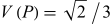 is the volume. Replacing
the integrand by
 gives the mean distance
from the
 -axis. The factor 8 uses reflection symmetry
of both the region and the integrand.
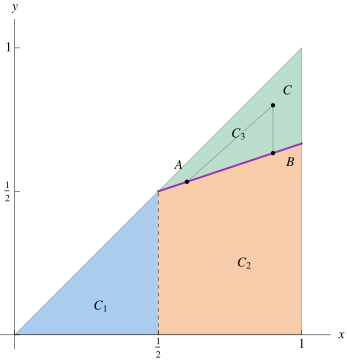
 and
 in the triangle
 . For the moving point
 ,
the signed triangle area is









 and
 and positive sign on
 . The absolute value in
the integrand can therefore be replaced by the appropriate
signed expression on each cell. The vertical split at
 makes the projections of
the cells onto the
 -axis identical or disjoint.
Lower-dimensional cell boundaries have zero area. The full
picking integral ranges over all six vertex coordinates.
 can retain the open disk
 and omit its boundary. The unit
circle alone has no full-dimensional cell in
 .
 x1,
x2, ...
 ] performs cylindrical algebraic decompositions in the Wolfram
Language. Although the process is algorithmic, it can become computationally
expensive as the number of variables increases.
