


A tent tile is a compact set defined by the contracting algebraic conjugates of the branches of an
asymmetric tent map associated with a special
Pisot number that is an algebraic unit (Scheicher et
al. 2026). For a Pisot number  ,
put
 . The number
 is special when
 is also a Pisot number,
and the asymmetric tent map is
 |
(1)
|
There are exactly 11 special Pisot numbers (Smyth 1999, p. 1). The exceptional value 2 is not an algebraic unit. The remaining ten values yield two one-dimensional, six planar, and two three-dimensional tent tiles (Scheicher et al. 2026).
In the planar case, let  be the algebraic conjugate of
 with positive imaginary
part, and put
 . The two contraction
mappings
 and
 define the tent tile
 by the iterated
function system
 |
(2)
|
Each tent tile is the closure of its nonempty interior. The planar examples therefore have positive area, despite their fractal boundaries (Scheicher et al. 2026).
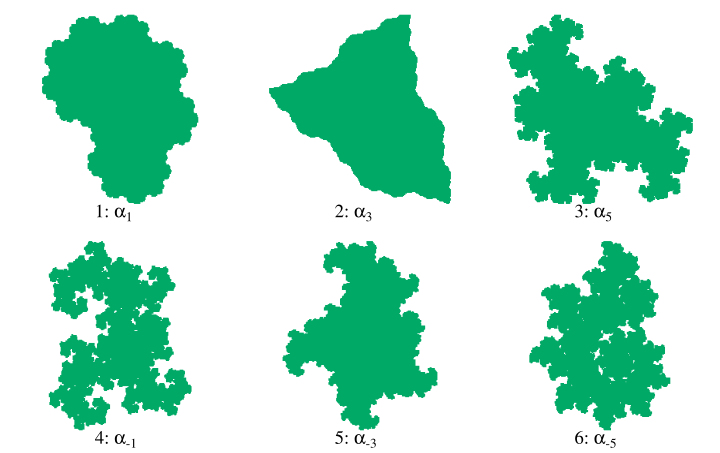
The six planar tent tiles are illustrated above in reading order. The table gives the corresponding minimal polynomials of  , the Hausdorff
dimension
 of the boundary, and the periodic tiling
constructions established by Scheicher et al. (2026). A half-turn means a
rotation through
 , as in
 ,
rather than a reflection in a line.
The constructions using half-turns do not assert that half-turns are necessary. An
unresolved row means that the paper establishes neither of these types of point
lattice tiling.
| figure | parameter | minimal polynomial |  (approx.) | periodic construction |
| 1 |  |  | 1.10026 | translations |
| 2 |  |  | 1.02952 | translations and half-turns |
| 3 |  |  | 1.37858 | unresolved |
| 4 |  |  | 1.70018 | translations and half-turns |
| 5 |  |  | 1.25074 | translations and half-turns |
| 6 |  |  | 1.92089 | unresolved |
The parameters in the second and third rows are the supergolden ratio and plastic constant, respectively.
Tent tiles are related to Rauzy fractals through
substitution systems, but a common algebraic
number does not identify the same attractor. For
example, the Rauzy fractal studied by Gjini (2001,
pp. 305-306) also uses  , but its boundary
has Hausdorff dimension approximately 1.47131
(Gjini 2001, pp. 317-319). It is therefore not similar
to either the second or the third tent tile.

The figure shows a nonagon seed for the tent tile associated with the plastic constant (E. Pegg, Jr.,
pers. comm., Nov. 6, 2026). With  the upper nonreal conjugate
of the plastic constant, the vertices
in order are
 for
 , 1, ..., 7, followed by
 .
The two maps are
 and
 . Since
 and
 ,
these are the maps of the third tent tile in coordinates scaled and rotated by
 . The panels show the seed, its two first
images, and the approximation after 27 steps. At each step, every largest copy is
replaced by the two children shown in the middle panel, transformed by the parent's
similarity. If instead both maps
are applied to every polygon at each step, two of the
four second-step polygons have overlapping interiors.

Omitting the last vertex  gives an octagon seed for the
same two maps (E. Pegg, Jr., pers. comm., Nov. 7,
2026). The right panel shows the patch after six steps of replacing all largest copies
at each step. The highlighted gap is a quadrilateral similar to the polygon with vertices
 ,
 ,
 ,
and
 , the quadrilateral illustrated in the plastic
constant entry.

The same octagon seed can also approximate the Hokkaido fractal (E. Pegg, Jr., pers. comm., Nov. 8, 2026). The columns compare
the two rules, showing the first replacement and the approximation after 32 steps.
With  as above, the left column uses
 and
 . The right column
uses
 and
 ,
obtained by conjugating the Hokkaido fractal
maps by the similarity
 .
Both rules use the same two scale factors,
 and
 . The reported boundary Hausdorff dimensions of the limiting fractals
are approximately 1.37858 and 1.10026, respectively (Akiyama and Sadahiro 1998, Scheicher
et al. 2026), so the two are not similar.

 ."
Osaka J. Math. 38, 303-319, 2001.