


A space-filling tetrahedron is a tetrahedron whose congruent copies can tile three-dimensional Euclidean space. The regular tetrahedron is not space-filling.
Sommerville (1922) described four space-filling tetrahedra in Euclidean space. Goldberg (1974) subsequently noted five individual cases in the literature and added three infinite families. Three of Sommerville's examples had previously been described by Hill (1895). Baumgartner (1968) later independently rediscovered three and found an additional example (Eppstein et al. 2004).
A  -reptile
tetrahedron can be dissected into
-reptile
tetrahedron can be dissected into  mutually congruent tetrahedra
similar to the original. Every such tetrahedron is space-filling.
In three dimensions, a
mutually congruent tetrahedra
similar to the original. Every such tetrahedron is space-filling.
In three dimensions, a  -reptile tetrahedron can exist only when
  , so 8 is the least possible nontrivial value (Kynčl
and Patáková 2017).
, so 8 is the least possible nontrivial value (Kynčl
and Patáková 2017).
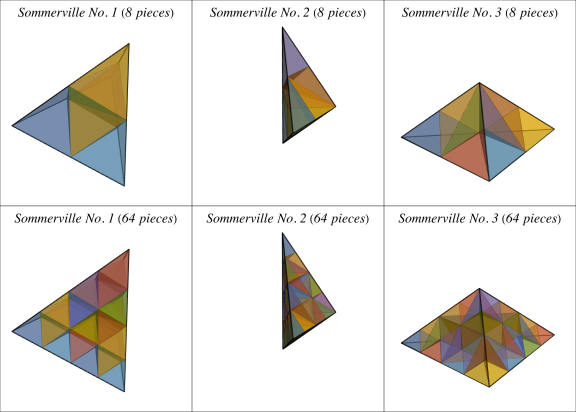
The first three Sommerville tetrahedra are rep-tiles with  .
Each can be subdivided through the midpoints of its
six polyhedron edges into eight mutually congruent
copies with scale factor
.
Each can be subdivided through the midpoints of its
six polyhedron edges into eight mutually congruent
copies with scale factor  (Liu and Du 2015, Kynčl and Patáková
2017). Repeating the subdivision once gives 64 congruent
copies with scale factor
(Liu and Du 2015, Kynčl and Patáková
2017). Repeating the subdivision once gives 64 congruent
copies with scale factor  .
.
In the complete classification of rational tetrahedra (Kedlaya et al. 2020), all members of the first (Hill) one-parameter family
are space-filling. The second family contributes no additional space-fillers, since
its only space-filling member at  also belongs to the first family. Chentouf and Sun (2023)
also ruled out 19 of the 59 sporadic rational tetrahedra, leaving at most 40 as possible
space-fillers.
also belongs to the first family. Chentouf and Sun (2023)
also ruled out 19 of the 59 sporadic rational tetrahedra, leaving at most 40 as possible
space-fillers.
Among tetrahedra of unit volume that tile Euclidean space, Sommerville type 4v has the least surface area (Bongiovanni et al. 2020). Among subdivision-invariant tetrahedra, Sommerville No. 2 is closest to a regular tetrahedron and optimal under several common shape measures (Liu and Du 2015). An interactive visualization of space-filling tetrahedra is given by Pegg (2010).
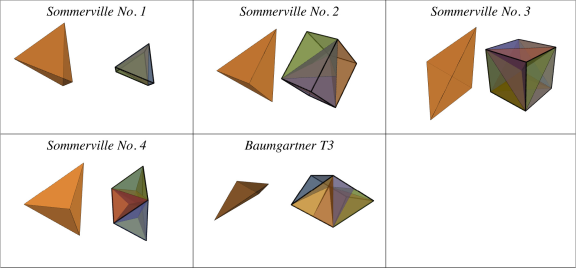
The five panels illustrated below show fixed representatives traditionally named Sommerville Nos. 1-4 and Baumgartner T3. In each panel, the orange tetrahedron at left is the seed and the multicolored solid at right is a triangular prism, parallelepiped, cube, or oblique triangular prism assembled from congruent copies.
In the numbering used by Pegg (2023), the second sporadic rational tetrahedron is congruent to Sommerville No. 2.
It can be represented by the vertices  ,
,  ,
,  , and
, and  . Its dihedral angles
along polyhedron edges
. Its dihedral angles
along polyhedron edges  ,
,  ,
,  ,
,  ,
,  , and
, and  are
are  ,
,  ,
,  ,
,  ,
,  , and
, and  , respectively.

 -Reptile Simplices in
  and
and  ." Elec. J. Combin. 24, P3.1, 2017.
  Pegg, E. Jr. "Space-Filling Tetrahedra." Wolfram Demonstrations
Project, 2010.
Pegg, E. Jr. "Space-Filling Tetrahedra." Wolfram Demonstrations
Project, 2010.