


A removable discontinuity of a real-valued function  at an accumulation point
  of its domain occurs when the
finite limit
of its domain occurs when the
finite limit
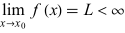 |
(1)
|
exists, but  is either undefined or unequal to
  . Removable discontinuities are so named because one can "remove"
this point of discontinuity by defining an almost
everywhere identical function
. Removable discontinuities are so named because one can "remove"
this point of discontinuity by defining an almost
everywhere identical function  of the form
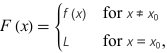 |
(2)
|
which is continuous at  .
.
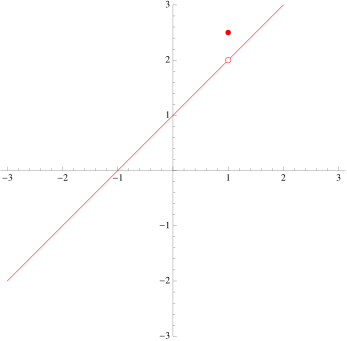
The figure above shows the piecewise function
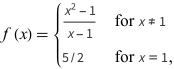 |
(3)
|
a function for which  while
while  . In particular,
  has a removable discontinuity at
  due to the fact that defining a function
  as discussed above and satisfying
  would yield an everywhere-continuous version of
  .
.
For example,  on its natural domain has a removable discontinuity at
 ,
since its limit there is 1. Extending the function
by setting
,
since its limit there is 1. Extending the function
by setting  gives the sinc function.
A removable discontinuity can be eliminated by changing the value at one point, unlike a jump discontinuity, an infinite discontinuity, or an oscillatory discontinuity.
The definition extends to removable discontinuities of multivariate functions.
Removable discontinuities are strongly related to the notion of removable singularities.
