


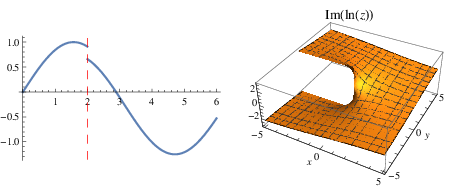
A discontinuity of a function is a point at which the function is discontinuous.
The left figure above illustrates a discontinuity in a one-variable function,
while the right figure illustrates a discontinuity of a two-variable function
plotted as a surface in  . In the latter case, the discontinuity is a branch
cut along the negative real axis of the natural
logarithm
. In the latter case, the discontinuity is a branch
cut along the negative real axis of the natural
logarithm  for complex
  .
.
Some authors refer to a discontinuity of a function as a jump, though this is rarely utilized in the literature.
For a one-variable real-valued function  , several common types of discontinuity
are distinguished.
, several common types of discontinuity
are distinguished.
1. At a removable discontinuity, a finite two-sided limit exists, but the function is undefined at the point or has a different value there.
2. At a jump discontinuity, both finite one-sided limits exist but are unequal.
3. At an infinite discontinuity, at least one one-sided limit is  or
or  .
.
4. At an oscillatory discontinuity, the limit fails to exist because the function continues to oscillate arbitrarily near the point.
These types are useful descriptions rather than an exhaustive classification of every possible failure of a limit. In particular, a function can fail to have a limit without having a jump, becoming unbounded, or exhibiting this type of oscillation.
Even with these descriptions, the sets of discontinuity of univariate real-valued functions may be stranger than expected. Indeed, functions may be discontinuous at finite sets of points, at countable sets of points which may be either isolated or dense, and on uncountable proper subsets of their domain. Other functions, such as the Dirichlet function, are discontinuous everywhere. Even so, the size of the discontinuity set of a function can say a lot about its analytic properties. For example, a theorem of Lebesgue states that a bounded univariate real-valued function defined on a bounded interval is Riemann integrable iff it is continuous almost everywhere (Royden and Fitzpatrick 2010); similarly, the sets of discontinuities of univariate monotone real-valued functions defined on open intervals are at most countable subsets of their domain.
With functions of two or more variables, however, no simple discontinuity classification is possible. There are a number of caveats which hinder any classification of the discontinuities of multivariate functions, chief among which is the fact that multivariate functions need neither jump nor "blow up" at points of discontinuity (Lady 1998). What's more, discontinuities of several-variable functions may occur along entire curves in the plane rather than at individual points. Various examples of discontinuous behavior are shown below.
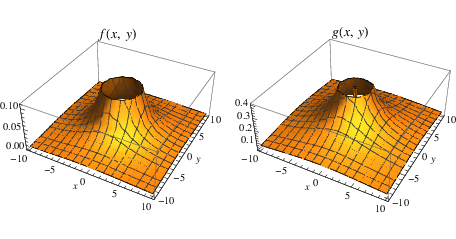
The left function above has an infinite discontinuity at the origin. It is the function  , which has the property
that each of the directional limits of
, which has the property
that each of the directional limits of  tends to
  as
as  approaches
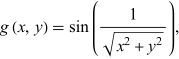
  . The right function is
 |
(1)
|
a bounded function with an oscillatory discontinuity as  . The function
  represents the surface obtained
by revolving the function
represents the surface obtained
by revolving the function  about the
  -axis.
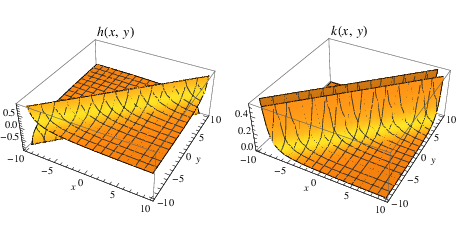
The two functions shown in the above figure are in some ways similar to the functions  and
and  described above. More precisely, the function
  on the left has infinite
discontinuity along the entire line
on the left has infinite
discontinuity along the entire line  and the limit of
  approaches
  from both sides of that line. On the other hand, the
function
from both sides of that line. On the other hand, the
function  on the right has infinite discontinuity along the same line, but the limits of the
values of
on the right has infinite discontinuity along the same line, but the limits of the
values of  disagree on either side of that line.
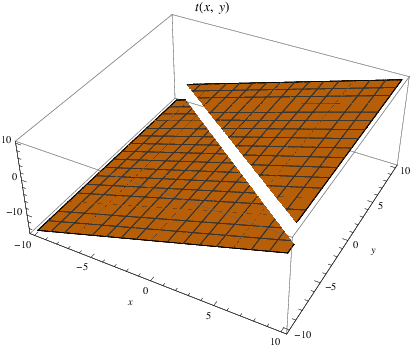
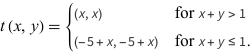
The function shown above is the piecewise function
 |
(2)
|
In particular, note that  is monotone in each of
  and
and  separately and has jump discontinuity along the entire line
 . This is in stark contrast to the
univariate case, as discussed above.
. This is in stark contrast to the
univariate case, as discussed above.
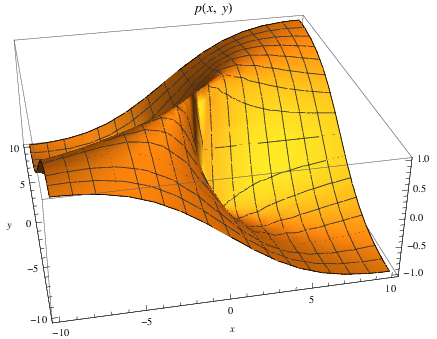
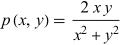
The function  defined by
 |
(3)
|
is shown in the figure immediately above. Like the functions  and
and  defined previously, the function
  has a discontinuity at the point
  , though unlike those functions, the point discontinuity
of
, though unlike those functions, the point discontinuity
of  is more difficult to recognize. One way to observe and understand the discontinuity
of
is more difficult to recognize. One way to observe and understand the discontinuity
of  is by converting
  to a function of the polar coordinates
  and
and  , the result of which is the function
  having the form
 |
(4)
|
Among other things, the expression in (3) above shows that  (and hence
  ) is constant on all lines through the origin (Lady 1998),
thereby confirming the existence of a discontinuity there. This example is also unlike
the cases outlined for univariate functions due to the fact that its discontinuity
is essential (i.e., it is not removable) and is neither a jump nor an infinite discontinuity.
) is constant on all lines through the origin (Lady 1998),
thereby confirming the existence of a discontinuity there. This example is also unlike
the cases outlined for univariate functions due to the fact that its discontinuity
is essential (i.e., it is not removable) and is neither a jump nor an infinite discontinuity.
Despite behaving very differently in terms of continuity, the sets of discontinuities of all real-valued functions in any dimension share certain properties. For example,
the collection of discontinuities of such a function is always an  set; this is due to the fact that the set of all points
at which a function is continuous form a
set; this is due to the fact that the set of all points
at which a function is continuous form a  set (Royden and Fitzpatrick 2010).
