


An infinite discontinuity of a real-valued function  at
at  occurs when at least one of the one-sided limits
is
occurs when at least one of the one-sided limits
is  or
or  .
Thus
.
Thus  is unbounded in every corresponding one-sided neighborhood
of
is unbounded in every corresponding one-sided neighborhood
of  .
This differs from an oscillatory discontinuity,
where the limit fails to exist because of persistent oscillation
rather than unbounded growth.
.
This differs from an oscillatory discontinuity,
where the limit fails to exist because of persistent oscillation
rather than unbounded growth.
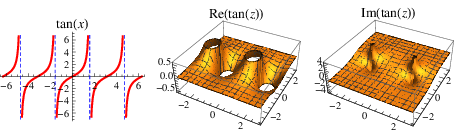
The figure above shows the tangent function, whose vertical asymptotes are commonly described as infinite discontinuities. Strictly speaking, a point on a vertical asymptote need not belong to the domain of the function. The term is therefore often used for the behavior of a function at an accumulation point of its domain, whether or not the function is defined at that point.
The definition extends to infinite discontinuities of multivariate functions.
