


The term domain has (at least) three different meanings in mathematics.
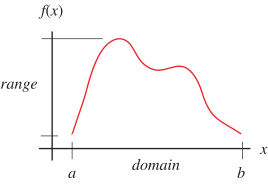
The term domain is most commonly used to describe the set of inputs  for which a function (map,
transformation, etc.) is defined. For a function
for which a function (map,
transformation, etc.) is defined. For a function
 ,
,  is the codomain, while the set
of values actually taken by
is the codomain, while the set
of values actually taken by  is the range
  . For example, a function
  that is defined for real values
  has domain
  , and is sometimes said to be "a function over
the reals."
, and is sometimes said to be "a function over
the reals."
Unfortunately, the term range is sometimes used in probability theory to mean domain (Feller 1968, p. 200; Evans et al. 2000). To confuse matters even more, the term "range" is more commonly used in statistics to refer to a completely different quantity, known in this work as the statistical range. As if this wasn't confusing enough, Evans et al. (2000, p. 6) define a probability domain to be the range of the distribution function of a probability density function.
The domain (in its usual established mathematical sense) of a probability density function (and therefore also its distribution function) is available with the undocumented Wolfram Language command DistributionDomain[dist].
The meaning of "domain" in topology is a connected open set.
Another meaning of "domain" is what is more properly known as an integral domain, i.e., a ring that is commutative under multiplication, has an identity element, and no divisors of 0.
