


The Rayleigh quotient of a Hermitian matrix  and a nonzero vector
 is
 |
(1)
|
where  denotes the conjugate transpose. It is real and is unchanged when
 is multiplied by a nonzero scalar.
If  are the eigenvalues of
 , then
 |  |  |
(2)
|
 |  |  |
(3)
|
To see this, expand  in an orthonormal basis of eigenvectors.
The quotient becomes the convex combination
 |
(4)
|
Its stationary values subject to  are precisely the eigenvalues,
attained at the corresponding eigenvectors.
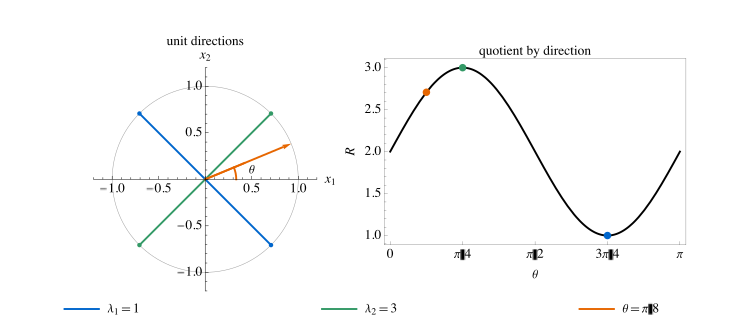
For example, take the symmetric matrix  with
 and
 . Its eigenvalues
are 1 and 3. For the unit vector
 , the quotient is
 |
(5)
|
The figure above marks the eigenvector directions and the sample direction  .
For a positive definite matrix  , the generalized quotient is
 |
(6)
|
Its stationary values are the generalized eigenvalues defined by  .
For a self-adjoint operator  on a Hilbert
space, the corresponding expression is
 |
(7)
|
for nonzero  in the operator's domain.
If
 is bounded below and has a lowest eigenvalue
 , then
 , with equality at a lowest eigenfunction
(Teschl 2009, pp. 118-119). Restricting the trial functions
to a finite-dimensional subspace gives the Rayleigh-Ritz
variational technique.
