

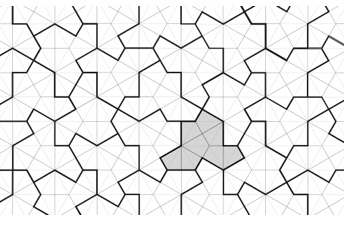
An aperiodic monotile, also somewhat humorously known as an einstein (where "einstein" means "one stone", perhaps generalizable to "one tile," in German), is a single tile that admits a tiling of a Euclidean space but no periodic tiling. The problem of finding such a tile in the plane was open for a long time. It was solved by Smith et al. (2023), who found a simple polykite known as a hat that is an aperiodic monotile.
In addition to the hat, Smith et al. (2023) also found a continuum of aperiodic polygonal monotiles.
A monotile is called strongly aperiodic if it admits a tiling but no admitted tiling has a symmetry group containing an element of infinite order. Some authors instead reserve "strongly aperiodic" for the stricter condition that every admitted tiling has a trivial symmetry group, calling the finite-symmetry case mildly aperiodic (Tsiokos 2026).
Tsiokos (2026) constructed a three-dimensional monotile called Chair44 that is strongly aperiodic in the first sense. It is a polyhedron with rational vertex coordinates that is homeomorphic to a closed three-dimensional ball, formed from a seven-cube chair whose 24 exposed unit-square panels carry small square-pyramid features. Tsiokos proved that congruent copies, with reflections allowed, tile three-dimensional Euclidean space, but the symmetry group of every such tiling is finite (Pegg 2026, Tsiokos 2026).

 Pegg, E. "Einstein Problem Solved (Aperiodic
Monotile Discovery)." Mar 21, 2023.
Pegg, E. "Einstein Problem Solved (Aperiodic
Monotile Discovery)." Mar 21, 2023.