

The prime nu function is the arithmetic function on the positive integers given by
 |
(1)
|
when the prime factorization of  is
is
 |
(2)
|
where the  are distinct primes and the
  are positive integers.
Thus
are positive integers.
Thus  counts the number of distinct prime factors
of
counts the number of distinct prime factors
of  ,
without multiplicity, and
,
without multiplicity, and  . It is implemented in the Wolfram
Language as PrimeNu[n].
. It is implemented in the Wolfram
Language as PrimeNu[n].
The first few values of  for
for  , 2, ... are 0, 1, 1, 1, 1, 2, 1, 1, 1, 2, 1, 2, 1, 2, 2,
1, 1, 2, 1, 2, ... (OEIS A001221, Kac 1959,
Abramowitz and Stegun 1972). For example,
, 2, ... are 0, 1, 1, 1, 1, 2, 1, 1, 1, 2, 1, 2, 1, 2, 2,
1, 1, 2, 1, 2, ... (OEIS A001221, Kac 1959,
Abramowitz and Stegun 1972). For example,  because
  has the two distinct
prime factors 2 and 3. The sequence is the inverse Möbius
transform of
has the two distinct
prime factors 2 and 3. The sequence is the inverse Möbius
transform of  ,
where
,
where  is the characteristic function of the
prime numbers (Sloane and Plouffe 1995, p. 22).
is the characteristic function of the
prime numbers (Sloane and Plouffe 1995, p. 22).
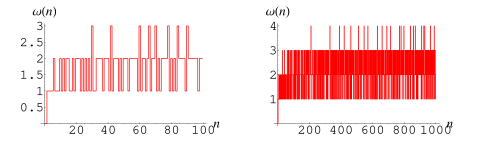
The function is strongly additive,
 |
(3)
|
when  and
and  are relatively prime, while
  for every prime
  and positive
integer
and positive
integer  .
Some authors denote the function by
.
Some authors denote the function by  (Hardy and Wright 1979, p. 354). Care is needed,
since
(Hardy and Wright 1979, p. 354). Care is needed,
since  can instead denote the number of all divisors of
  (Ore 1988, p. 86).
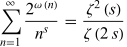
A sum involving  is
is
 |
(4)
|
for  (Hardy and Wright 1979, p. 255).
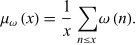
For a positive integer  , let
, let
 |
(5)
|
An asymptotic series for this mean is
 |
(6)
|
where  is the Mertens constant and the
  are Stieltjes constants
(Diaconis 1976, Knuth 2000, Diaconis 2002, Finch 2003). The corresponding variance
over the integers 1, 2, ...,
are Stieltjes constants
(Diaconis 1976, Knuth 2000, Diaconis 2002, Finch 2003). The corresponding variance
over the integers 1, 2, ...,  has expansion
 |
(7)
|
where
 |  |  |
(8)
|
 |  |  |
(9)
|
(Finch 2003, p. 7), and
 |
(10)
|
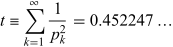
(OEIS A085548) is the prime zeta function 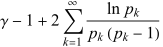 (Finch 2003). The coefficients are
 |  | 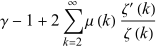 |
(11)
| ||
 |  |  |
(12)
| ||
 |  | 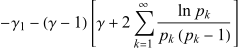 |
(13)
| ||
 | 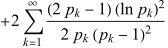 | ![-gamma_1-(gamma-1)[gamma+2sum_(k=1)^(infty)(lnp_k)/(p_k(p_k-1))]](/images/equations/PrimeNuFunction/Inline45.svg) |  |  |
(14)
|
 |  |  |
(15)
|
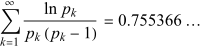
Equivalently, the sums occurring here have values
 |  |  |
(16)
|
 |  |  |
(17)
|
(Finch 2003).
The average order of  is
is  (Hardy 1999, p. 51). If
  is a primorial, then
 |
(18)
|
(Hardy and Wright 1979, p. 355). Its summatory function satisfies
 |
(19)
|
where  is the Mertens constant (Hardy and Ramanujan
1917; Hardy and Wright 1979, p. 355; Hardy 1999, p. 57). The first few
values of the summatory function for
is the Mertens constant (Hardy and Ramanujan
1917; Hardy and Wright 1979, p. 355; Hardy 1999, p. 57). The first few
values of the summatory function for  , 3, ... are 1, 2, 3, 4, 6, 7, 8, 9, 11, 12, 14, 15, 17,
19, 20, 21, ... (OEIS A013939). In addition,
, 3, ... are 1, 2, 3, 4, 6, 7, 8, 9, 11, 12, 14, 15, 17,
19, 20, 21, ... (OEIS A013939). In addition,
![sum_(k=2)^n[omega(k)]^2=n(lnlnn)^2+O(nlnlnn)](/images/equations/PrimeNuFunction/NumberedEquation11.svg) |
(20)
|
(Hardy and Wright 1979, p. 357).
The first few squarefree numbers  with an odd number of distinct
prime factors are 2, 3, 5, 7, 11, 13, 17, 19, 23, 29, 30, 31, 37, 41, 42, 43,
47, ... (OEIS A030059; Hardy 1999, p. 64;
Ramanujan 2000, pp. xxiv and 21). They satisfy
with an odd number of distinct
prime factors are 2, 3, 5, 7, 11, 13, 17, 19, 23, 29, 30, 31, 37, 41, 42, 43,
47, ... (OEIS A030059; Hardy 1999, p. 64;
Ramanujan 2000, pp. xxiv and 21). They satisfy
![sum_(n=1)^infty1/(u_n^s)=1/2[(zeta(s))/(zeta(2s))-1/(zeta(s))]](/images/equations/PrimeNuFunction/NumberedEquation12.svg) |
(21)
|
for  (Hardy 1999, pp. 64-65). If
  counts the
  , then
 |
(22)
|
(Hardy 1999, pp. 64-65).

 ." Dept. Statistics Tech. Report 96, Stanford, CA: Stanford
University, 1976.Diaconis, P. "G. H. Hardy and Probability???"
Bull. London Math. Soc. 34, 385-402, 2002.Finch, S. "Two
Asymptotic Series." Dec. 10, 2003.
." Dept. Statistics Tech. Report 96, Stanford, CA: Stanford
University, 1976.Diaconis, P. "G. H. Hardy and Probability???"
Bull. London Math. Soc. 34, 385-402, 2002.Finch, S. "Two
Asymptotic Series." Dec. 10, 2003.  ." Quart. J. Math. 48, 76-92, 1917.Hardy,
G. H. and Wright, E. M. §§22.10-22.11 in
." Quart. J. Math. 48, 76-92, 1917.Hardy,
G. H. and Wright, E. M. §§22.10-22.11 in