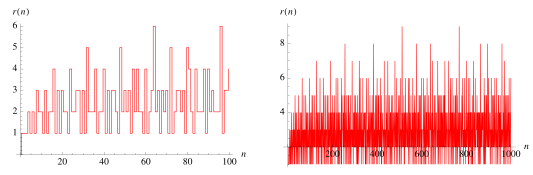
The first few values of for , 2, ... are 0, 1, 1, 2, 1, 2, 1, 3, 2, 2, 1, 3, 1, 2, 2,
4, 1, 3, 1, 3, ... (OEIS A001222). For example,
because .
In contrast, the prime nu function gives because it ignores multiplicity.
Conway et al. (2008) called the "multiprimality" of , and accordingly used the names biprime for a semiprime,
triprime when ,
and so on.
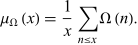
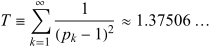
where ,
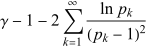
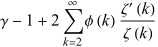
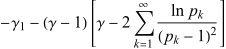
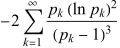
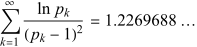
is the Mertens constant, is the th prime, and the are Stieltjes constants
(Diaconis 1976, Knuth 2000, Diaconis 2002, Finch 2003). The corresponding variance
over the integers 1, 2, ..., has expansion
Conway, J. H.; Dietrich, H.; and O'Brien, E. A. "Counting Groups: Gnus, Moas, and Other Exotica." Math. Intell.30,
6-18, 2008.Diaconis, P. "Asymptotic Expansions for the Mean and
Variance of the Number of Prime Factors of a Number ." Dept. Statistics Tech. Report 96, Stanford, CA: Stanford
University, 1976.Diaconis, P. "G. H. Hardy and Probability???"
Bull. London Math. Soc.34, 385-402, 2002.Erdős,
P. and Kac, M. "The Gaussian Law of Errors in the Theory of Additive Number
Theoretic Functions." Amer. J. Math.62, 738-742, 1940.Finch,
S. "Two Asymptotic Series." Dec. 10, 2003. https://web.archive.org/web/20160419150604/http://www.people.fas.harvard.edu/~sfinch/csolve/asym.pdf.Hardy,
G. H. Ramanujan:
Twelve Lectures on Subjects Suggested by His Life and Work, 3rd ed. New York:
Chelsea, 1999.Hardy, G. H. and Ramanujan, S. "The Normal Number
of Prime Factors of a Number ." Quart. J. Math.48, 76-92, 1917.Hardy,
G. H. and Wright, E. M. §§22.10-22.11 in An
Introduction to the Theory of Numbers, 5th ed. Oxford, England: Clarendon
Press, pp. 354-355, 1979.Knuth, D. E. The
Art of Computer Programming, Vol. 2: Seminumerical Algorithms, 3rd ed.
Reading, MA: Addison-Wesley, p. 384, 1998.Knuth, D. E. Selected
Papers on Analysis of Algorithms. Stanford, CA: CSLI Publications, pp. 338-339,
2000.Ramanujan, S. Collected
Papers of Srinivasa Ramanujan (Ed. G. H. Hardy, P. V. S. Aiyar,
and B. M. Wilson). Providence, RI: Amer. Math. Soc., p. 327, 2000.Sloane,
N. J. A. Sequences A001222/M0094,
A086242, and A091589
in "The On-Line Encyclopedia of Integer Sequences."Turán,
P. "On a Theorem of Hardy and Ramanujan." J. London Math. Soc.9,
274-276, 1934.Turán, P. "Über einige Verallgemeinerungen
eines Satzes von Hardy und Ramanujan." J. London Math. Soc.11,
125-133, 1936.


 is
is

 are distinct primes and the
  are positive integers.
Thus
are positive integers.
Thus  counts prime factors with multiplicity,
and
counts prime factors with multiplicity,
and  .
It is implemented in the Wolfram Language
as PrimeOmega[n].
.
It is implemented in the Wolfram Language
as PrimeOmega[n].
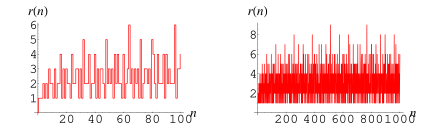
 for
for  , 2, ... are 0, 1, 1, 2, 1, 2, 1, 3, 2, 2, 1, 3, 1, 2, 2,
4, 1, 3, 1, 3, ... (OEIS A001222). For example,
, 2, ... are 0, 1, 1, 2, 1, 2, 1, 3, 2, 2, 1, 3, 1, 2, 2,
4, 1, 3, 1, 3, ... (OEIS A001222). For example,
 because
  .
In contrast, the prime nu function gives
.
In contrast, the prime nu function gives  because it ignores multiplicity.
 the "multiprimality" of
  , and accordingly used the names biprime for a semiprime,
triprime when
, and accordingly used the names biprime for a semiprime,
triprime when  ,
and so on.
,
and so on.

 and
and  . It determines the Liouville
function by
. It determines the Liouville
function by

 , let
, let

![B_2=B_1+sum_(k=1)^(infty)1/[p_k(p_k-1)]](/images/equations/PrimeOmegaFunction/Inline17.svg) ,
,
 is the Mertens constant,
  is the
  th prime, and the
  are Stieltjes constants
(Diaconis 1976, Knuth 2000, Diaconis 2002, Finch 2003). The corresponding variance
over the integers 1, 2, ...,
are Stieltjes constants
(Diaconis 1976, Knuth 2000, Diaconis 2002, Finch 2003). The corresponding variance
over the integers 1, 2, ...,  has expansion














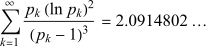
![-gamma_1-(gamma-1)[gamma-2sum_(k=1)^(infty)(lnp_k)/((p_k-1)^2)]](/images/equations/PrimeOmegaFunction/Inline40.svg)




 is chosen uniformly from 1 through
  , then the probability that

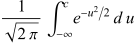
 (Erdős and Kac 1940; Knuth 1998, p. 384). This is the Erdős-Kac
theorem for
(Erdős and Kac 1940; Knuth 1998, p. 384). This is the Erdős-Kac
theorem for  .
.
 is
is  (Hardy 1999, p. 51). More precisely,

 is asymptotic notation (Hardy and Ramanujan
1917; Hardy and Wright 1979, p. 355; Hardy 1999, p. 57).
is asymptotic notation (Hardy and Ramanujan
1917; Hardy and Wright 1979, p. 355; Hardy 1999, p. 57).

 ." Dept. Statistics Tech. Report 96, Stanford, CA: Stanford
University, 1976.Diaconis, P. "G. H. Hardy and Probability???"
Bull. London Math. Soc. 34, 385-402, 2002.Erdős,
P. and Kac, M. "The Gaussian Law of Errors in the Theory of Additive Number
Theoretic Functions." Amer. J. Math. 62, 738-742, 1940.Finch,
S. "Two Asymptotic Series." Dec. 10, 2003.
." Dept. Statistics Tech. Report 96, Stanford, CA: Stanford
University, 1976.Diaconis, P. "G. H. Hardy and Probability???"
Bull. London Math. Soc. 34, 385-402, 2002.Erdős,
P. and Kac, M. "The Gaussian Law of Errors in the Theory of Additive Number
Theoretic Functions." Amer. J. Math. 62, 738-742, 1940.Finch,
S. "Two Asymptotic Series." Dec. 10, 2003.  ." Quart. J. Math. 48, 76-92, 1917.Hardy,
G. H. and Wright, E. M. §§22.10-22.11 in
." Quart. J. Math. 48, 76-92, 1917.Hardy,
G. H. and Wright, E. M. §§22.10-22.11 in