


The Möbius transform maps a sequence  ,
 , ... satisfying
 |
(1)
|
for positive integers  to the sequence
 ,
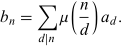
 , ... via the Möbius
inversion formula,
 |
(2)
|
where  is the Möbius function. The transformation
of the sequence
 to
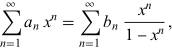
 is sometimes called the sum-of-divisors transform. An equivalent
generating function identity is
 |
(3)
|
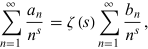
the right side of which is called a Lambert series. This is an identity of formal power series. The corresponding Dirichlet generating function identity is
 |
(4)
|
where  is the Riemann zeta function. The analytic
identity holds when
 and the series
 converges absolutely
(Sloane and Plouffe 1995, p. 21).
Example Möbius transformations (Sloane and Plouffe 1995, p. 22) include  for all
 , giving the inverse transform as
 , 2, 2, 3, 2, 4, 2, 4, 3, 4, 2, 6, ... (OEIS A000005), the divisor
function
 of
 . The Möbius transform of
 gives
 , 1, 2, 2, 4, 2, 6, 4, 6,
4, 10, 4, 12, ... (OEIS A000010), the totient
function of
 . The inverse Möbius transform
of the sequence
 for
 and
 for
 gives
 , 4, 0, 4, 8, 0, 0, 4, 4,
... (OEIS A004018), the sum
of squares function
 counting signed, ordered representations of
 as a sum of two squares.
The inverse Möbius transform of
 for prime
 and
 otherwise gives the sequence
 , 1, 1, 1, 1, 2, 1, 1, 1, ... (OEIS A001221),
the number of distinct prime factors of
 .
