An asymptotic series is a series expansion of a function in a variable which may converge or diverge (Erdélyi 1987, p. 1),
but whose partial sums can be made an arbitrarily good approximation to a given function
for large enough .
To form an asymptotic series of
(1)
take
(2)
where
(3)
The asymptotic series is defined to have the properties
(4)
(5)
Therefore,
(6)
in the limit .
If a function has an asymptotic expansion, the expansion is unique. The symbol is also used to mean directly similar.
Asymptotic series can be computed by doing the change of variable and doing a series expansion about zero. Many mathematical
operations can be performed on asymptotic series. For example, asymptotic series
can be added, subtracted, multiplied, divided (as long as the constant term of the
divisor is nonzero), and exponentiated, and the results are also asymptotic series
(Gradshteyn and Ryzhik 2000, p. 20).


 which may converge or diverge (Erdélyi 1987, p. 1),
but whose partial sums can be made an arbitrarily good approximation to a given function
for large enough
which may converge or diverge (Erdélyi 1987, p. 1),
but whose partial sums can be made an arbitrarily good approximation to a given function
for large enough  .
To form an asymptotic series
.
To form an asymptotic series  of
of

![x^nR_n(x)=x^n[f(x)-S_n(x)],](/images/equations/AsymptoticSeries/NumberedEquation2.svg)



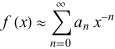
 .
If a function has an asymptotic expansion, the expansion is unique. The symbol
.
If a function has an asymptotic expansion, the expansion is unique. The symbol  is also used to mean directly similar.
 and doing a series expansion about zero. Many mathematical
operations can be performed on asymptotic series. For example, asymptotic series
can be added, subtracted, multiplied, divided (as long as the constant term of the
divisor is nonzero), and exponentiated, and the results are also asymptotic series
(Gradshteyn and Ryzhik 2000, p. 20).
and doing a series expansion about zero. Many mathematical
operations can be performed on asymptotic series. For example, asymptotic series
can be added, subtracted, multiplied, divided (as long as the constant term of the
divisor is nonzero), and exponentiated, and the results are also asymptotic series
(Gradshteyn and Ryzhik 2000, p. 20).
