TOPICS
Search

Mean Absolute Value


The mean absolute value of real data x_1, ..., x_n is the arithmetic mean of their absolute values,
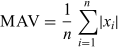
 MAV=1/nsum_(i=1)^n|x_i|
(1)

for n>=1. It is also called the average rectified value (Aarts 2021, p. 87).

For a real random variable X, the mean absolute value is the first absolute moment about zero,

 MAV=E[|X|],
(2)

provided this expectation value is finite (Geary 1947, p. 219). The mean deviation is obtained by first subtracting the mean from X. These quantities agree when the mean is zero.

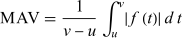
For a real function f on an interval [u,v] with u<v, the mean absolute value is

 MAV=1/(v-u)int_u^v|f(t)|dt
(3)

when the integral is finite. The ratio of the root-mean-square to the mean absolute value is the form factor.


See also

Absolute Moment, Absolute Value, Arithmetic Mean, Form Factor, Mean Deviation, Root-Mean-Square

Explore with Wolfram|Alpha

WolframAlpha

More things to try:

References

Aarts, R. M. "Tracking and Estimation of Frequency, Amplitude, and Form Factor of a Harmonic Time Series." IEEE Signal Process. Mag. 38, 86-91, 2021. https://doi.org/10.1109/MSP.2021.3090681.Geary, R. C. "Testing for Normality." Biometrika 34, 209-242, 1947. https://doi.org/10.1093/biomet/34.3-4.209.

Cite this as:

Weisstein, Eric W. "Mean Absolute Value." From MathWorld--A Wolfram Resource. https://mathworld.wolfram.com/MeanAbsoluteValue.html

Subject classifications