TOPICS
Search

Absolute Moment


The absolute moment of order r>0 about a real number a for a real random variable X is the expectation value

 M_r(a)=E[|X-a|^r].
(1)

The order r may be any positive real number. This nonnegative expectation value may be infinite. A finite absolute moment requires E[|X-a|^r]<infty (Geyer 2016, p. 55; Durrett 2019, p. 28).

If X has a probability density function p, then

 M_r(a)=int_(-infty)^infty|x-a|^rp(x)dx.
(2)

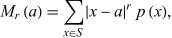
If X has a discrete distribution with probability mass function p(x)=P(X=x), the corresponding formula is

 M_r(a)=sum_(x in S)|x-a|^rp(x),
(3)

where S is its countable set of possible values (Durrett 2019, p. 32).


See also

Central Moment, Expectation Value, Moment, Raw Moment

Explore with Wolfram|Alpha

References

Durrett, R. Probability: Theory and Examples. Version 5, Jan. 11, 2019. Author manuscript. https://services.math.duke.edu/~rtd/PTE/PTE5_011119.pdf.Geyer, C. J. "Stat 5101 Lecture Slides: Deck 6." Minneapolis, MN: University of Minnesota, Spring 2016. https://www.stat.umn.edu/geyer/s16/5101/slides/s6.pdf.Papoulis, A. Probability, Random Variables, and Stochastic Processes, 2nd ed. New York: McGraw-Hill, p. 146, 1984.

Referenced on Wolfram|Alpha

Absolute Moment

Cite this as:

Weisstein, Eric W. "Absolute Moment." From MathWorld--A Wolfram Resource. https://mathworld.wolfram.com/AbsoluteMoment.html

Subject classifications