

The form factor, in the sense of a ratio of means, is the root-mean-square divided by the mean absolute value (Aarts 2021,
p. 87). For a real random variable  with
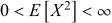 , it is
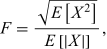 |
(1)
|
where  denotes the expectation
value. The Cauchy-Schwarz inequality gives
 , with equality iff
 is constant almost
surely. The form factor is unchanged by multiplication of
 by a nonzero real constant. It is undefined for an identically
zero input.
For  real data values
 ,
...,
 that are not all zero,
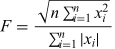 |
(2)
|
and
 |
(3)
|
The lower bound is attained when all  are equal, and the upper bound when exactly one value
is nonzero.
For a zero-mean normal distribution with positive standard deviation,  .
For a nonzero sinusoid averaged continuously over a
full period,
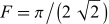 (Aarts 2021, pp. 88 and 91). For centered data, the reciprocal is the mean
deviation divided by the population
standard deviation, using the same
 averaging convention for both quantities (Geary 1947, p. 219).
